barnyard breeze . . .
breaking up the banter
bats in the banyan
Monica Kakkar
India and USA
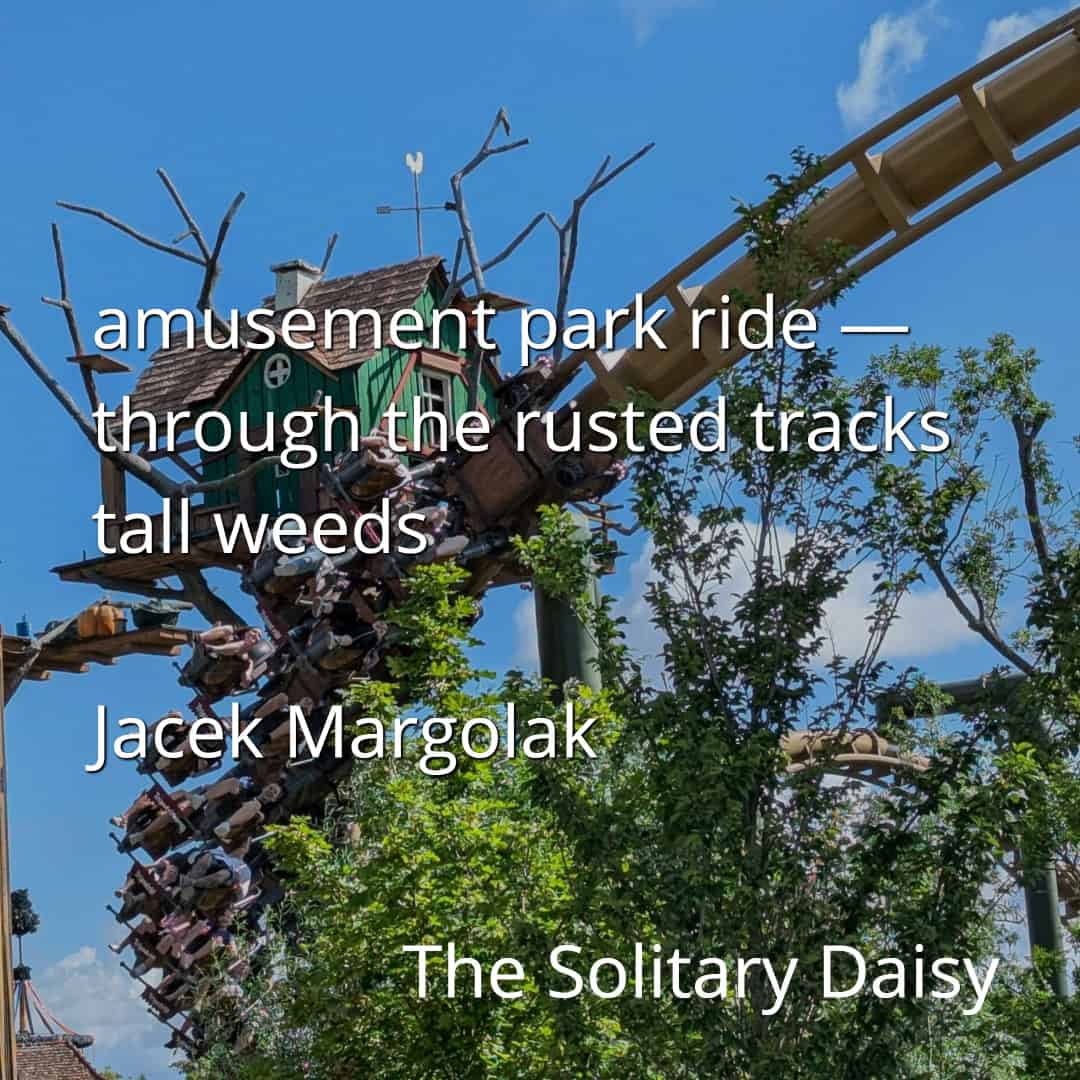
amusement park ride —
through the rusted tracks
tall weeds
Jacek Margolak
Poland
hometown festival—
t-shirts tie-dyed
red, white & blue
Julie Bloss Kelsey
Maryland, USA
gin-clear creek
a brook trout’s shadow
glides over gravel
AJ Johnson
Stephens City, VA USA
afternoon heat
the blackbird’s beak
still open
C.X. Turner
United Kingdom
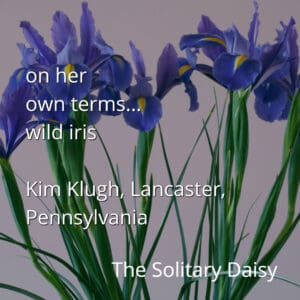
summer’s shifting clouds
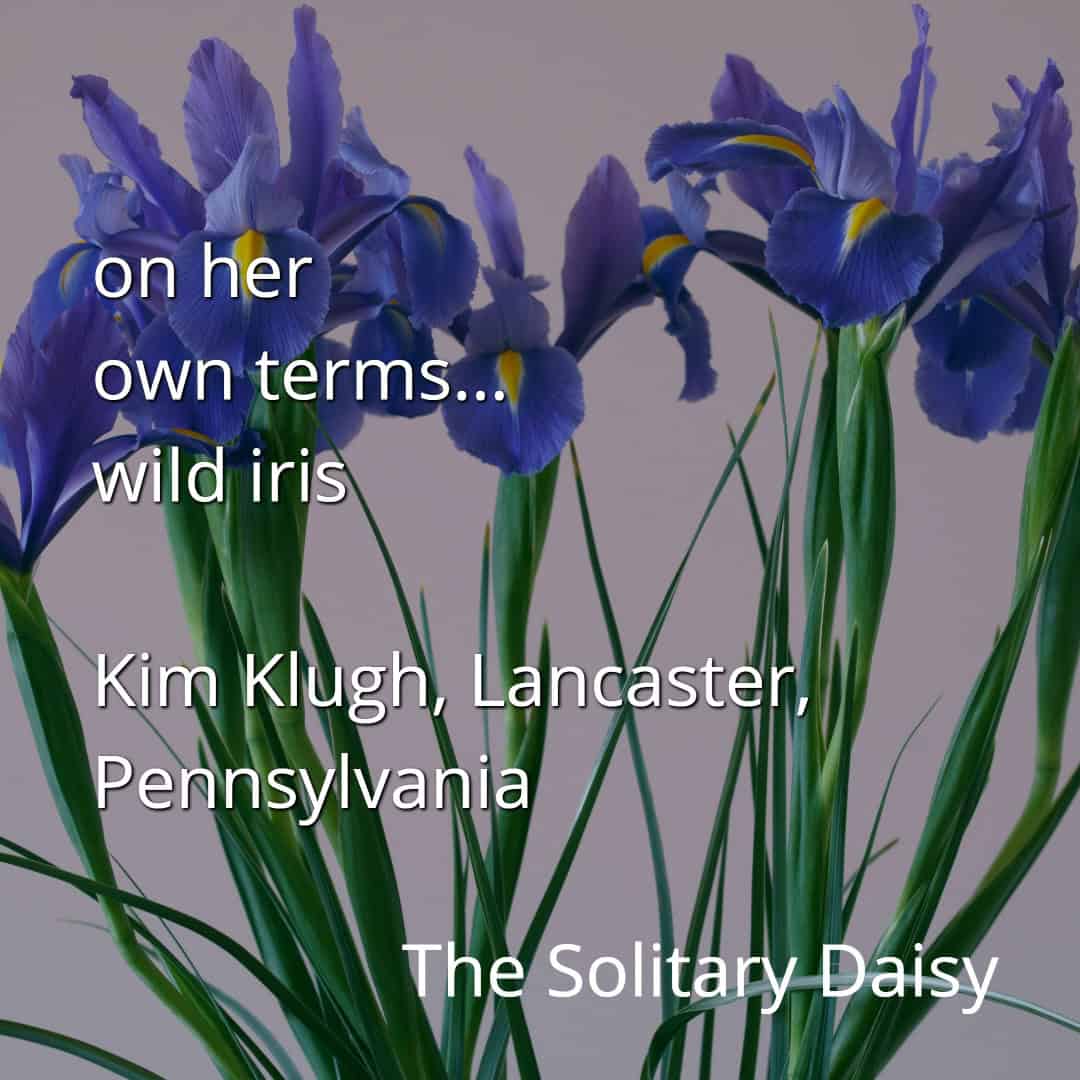
the different shapes
a life can take
Kim Klugh
Lancaster, Pennsylvania
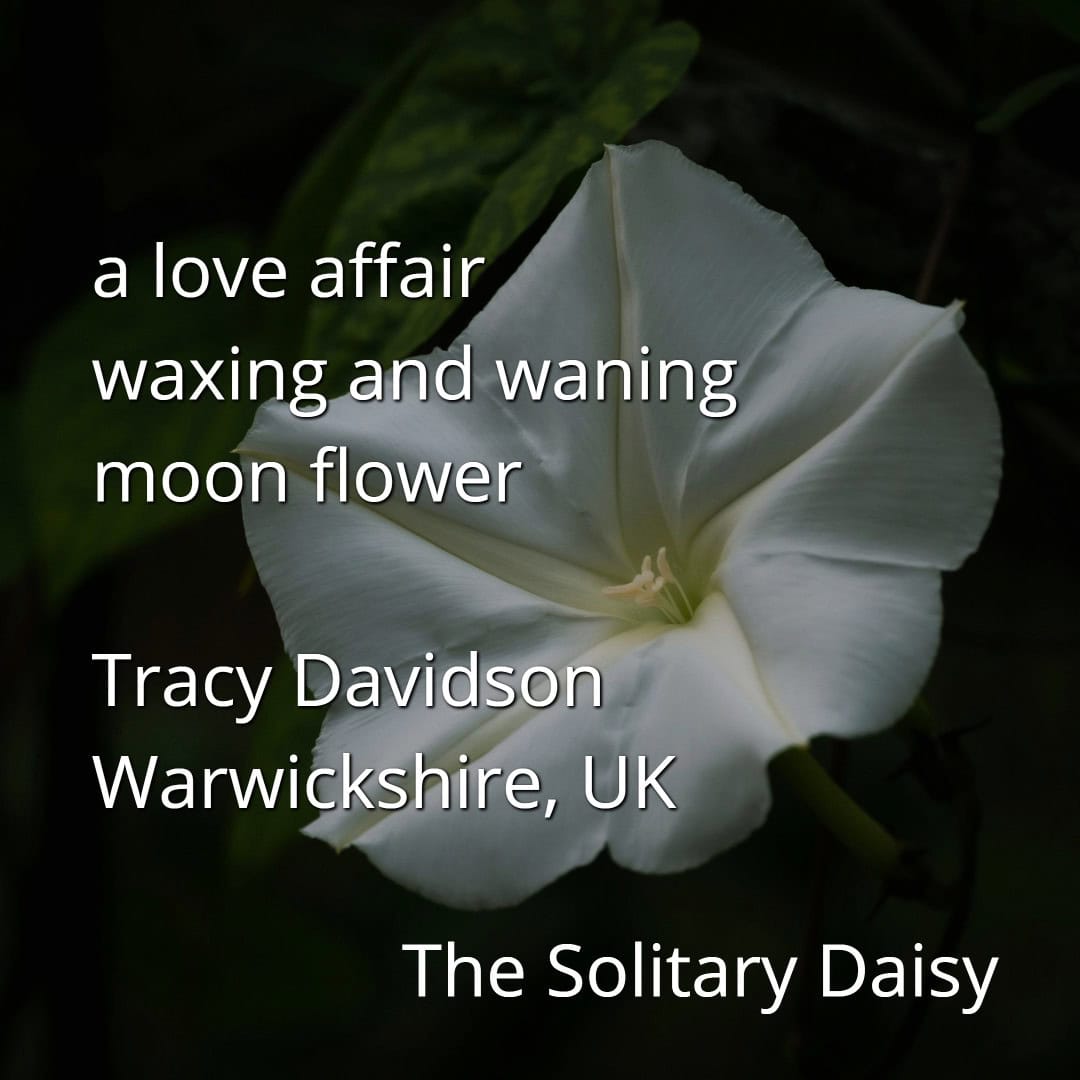
a love affair
waxing and waning
moon flower
Tracy Davidson
Warwickshire, UK
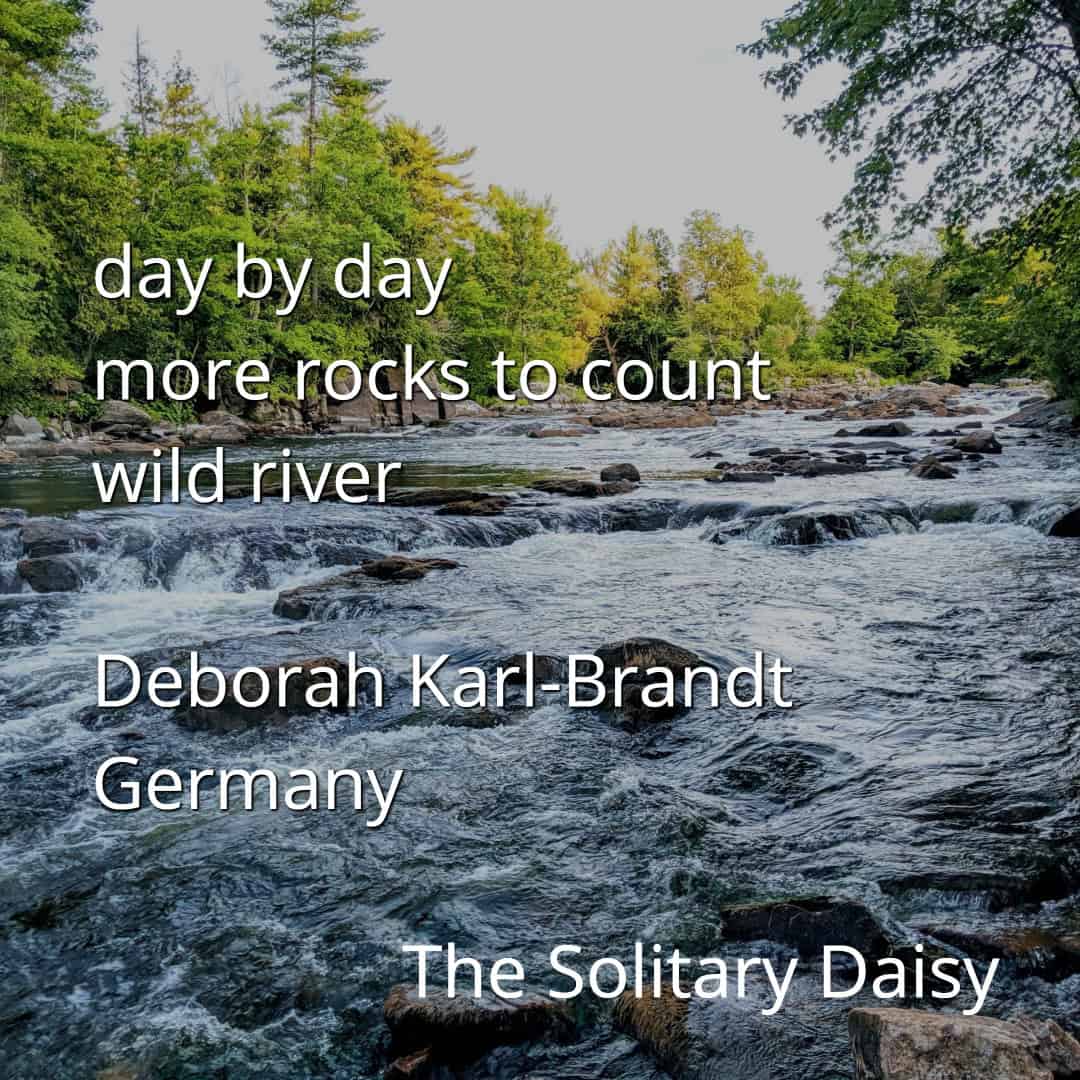
day by day
more rocks to count
wild river
Deborah Karl-Brandt
Germany
lavender breeze
rippling field after field
into purple
Chen-ou Liu
Ajax, Ontario, Canada
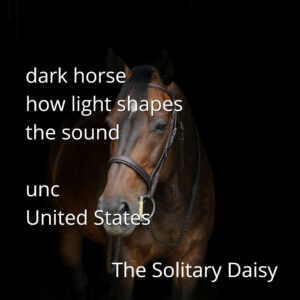
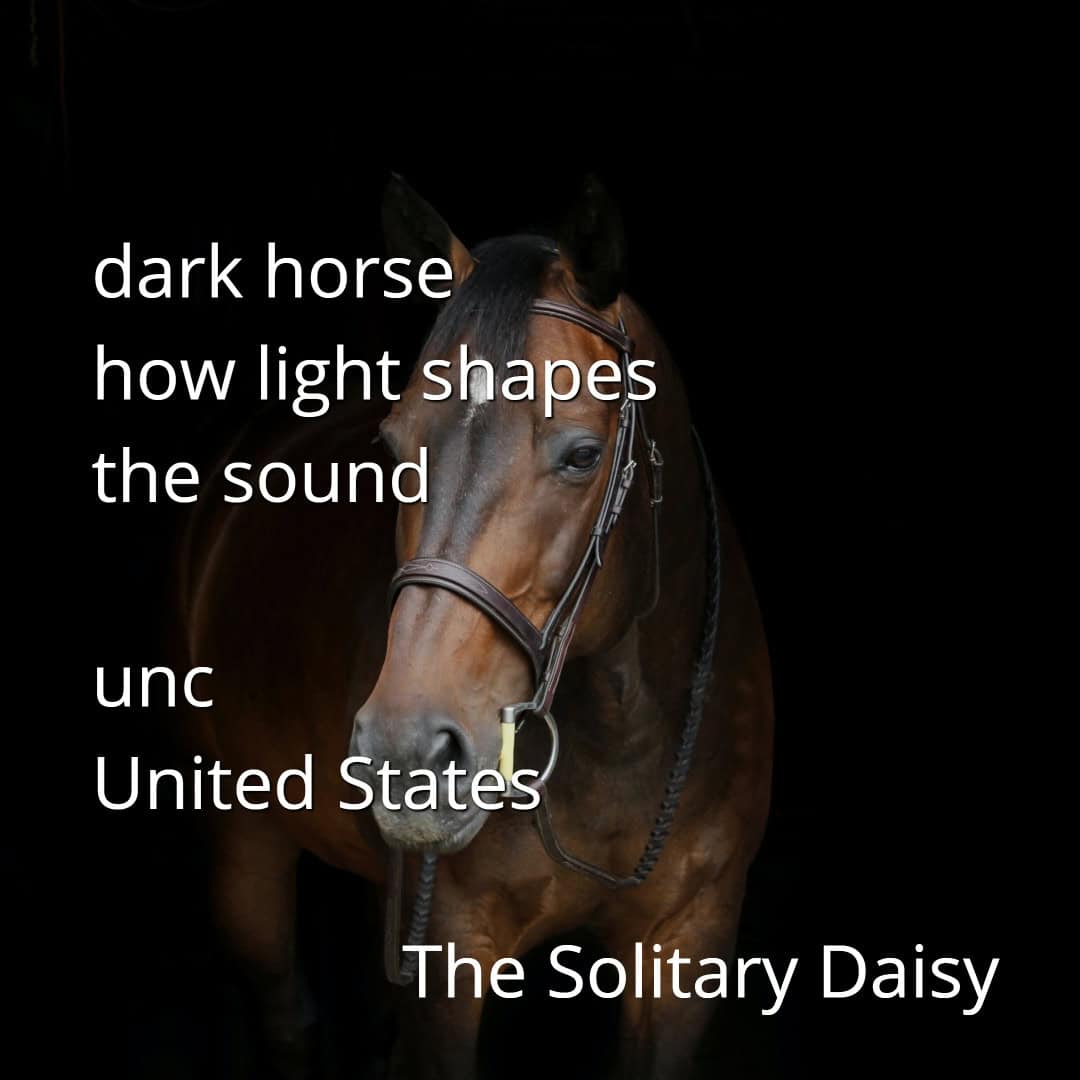
dark horse
how light shapes
the sound
unc
United States
the river keeps moving –
still the mountains
stand
Darlene Romanko,
Peachland, BC, Canada
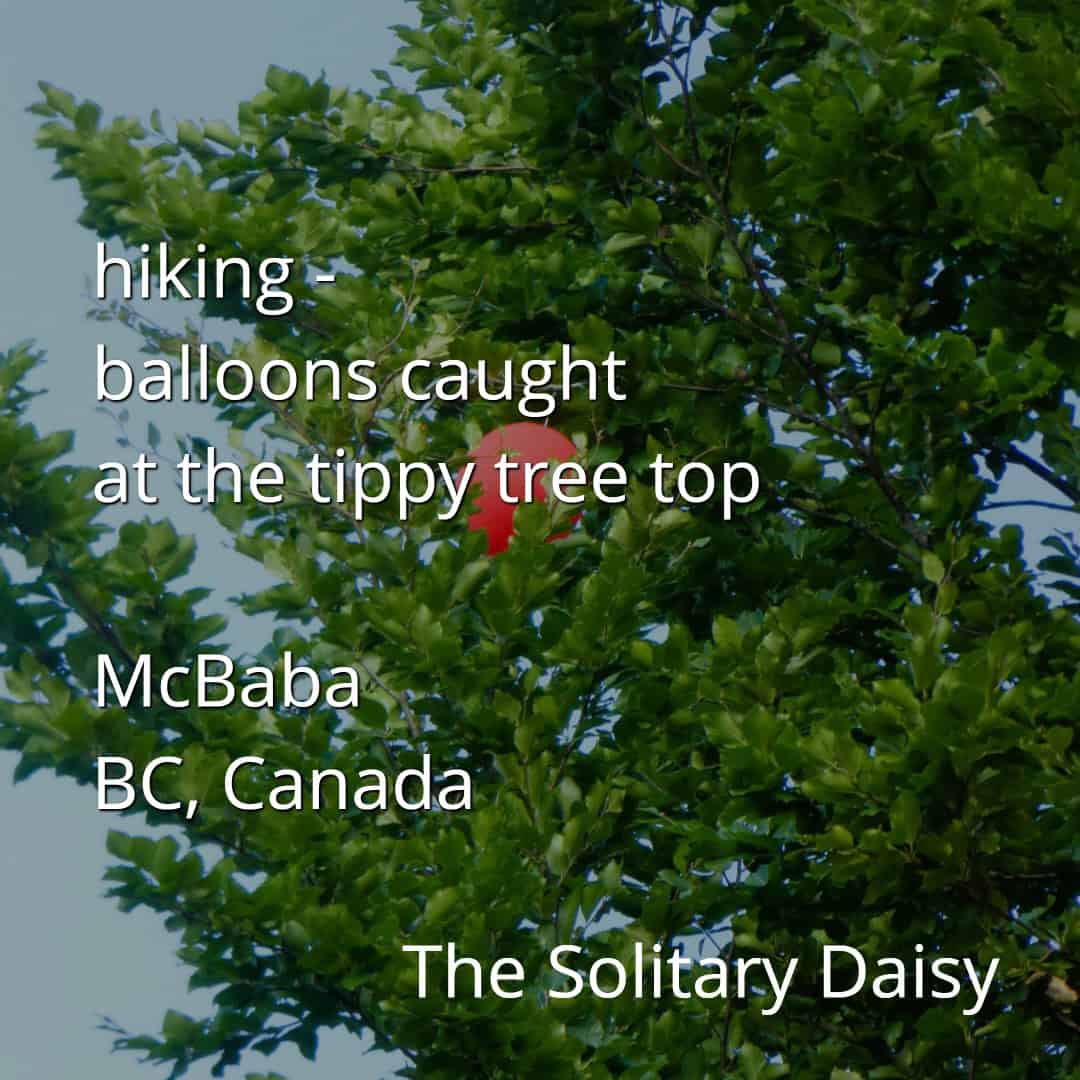
hiking -
balloons caught
at the tippy tree top
McBaba
BC, Canada



Michele’s Musings
Dear friends,
We cannot thank you enough for paying off the loan for our dear friend’s grandmother’s pacemaker! She is doing so well, walking around the hospital corridors and attending physio. She will be home soon!
Our webmaster had a planned surgery himself last week. He is recovering well although he is not terribly patient about it lol.
We all have quite a few plans over the summer and so will now be switching to our summer schedule. Our next issue will be August 1st and the one after that will be September 5th. We hope you will take the time to rest and rejuvenate from whatever you do in the rest of the year. And for our Southern Hemisphere friends, we wish you a comfortable, cozy winter!
Keep on writing!
Member News
Adele Gallogly
I recently had my first haibun published in Issue 32 of MacQueen’s Quinterly — an ekphrastic braided piece. My haiku have also been published in the Haiku Dialogue section of The Haiku Foundation’s blog — and I really enjoy responding to their themed prompts.
Adele Gallogly, Hamilton, Ontario, Canada
—
Roberta Beary
I have a free to download e-chapbook published by Buttonhook Press, called The Heart of Haibun, in the OJAL Master Series. Besides several haibun, It includes a craft essay on haibun and an interview. The cover artwork is by my brother, Kevin Beary.
Here’s the pdf:
https://ojalart.com/wp-content/uploads/Beary.Masters-proofed-ebook.pdf
Grace Cavalieri, Poet Laureate Emerita, Maryland, USA, recently featured my work on her Library of Congress podcast, The Poet and The Poem.
We talk for 1/2 hour about haiku, haibun and my new collection, Crazy Bitches (MacQ Press 2025). Here is the Apple Podcast link
Finally I am delighted to say that Crazy Bitches is a finalist in the Touchstone, Eric Hoffer, and Julie Suk book awards.
Roberta Beary
—
Debbie Strange
Debbie Strange is thrilled to announce that her haiku collection, Random Blue Sparks (Snapshot Press, 2024), received joint 1st Place in the 2026 Haiku Canada Marianne Bluger Book Awards, 3rd Place in the 2025 Haiku Society of America Merit Book Awards, and was shortlisted for a Haiku Foundation Touchstone Award. The book is available from Snapshot Press (UK), and Debbie has a limited number of copies available for shipping to Canadian addresses (author cost & postage = $20). Please visit Debbie’s publication archive at https://debbiemstrange.blogspot.com/ for further information.
—
Belinda Behne
I’m thrilled to have a haiku accepted
by Editor Katherine E. Winnick
for Issue VII of Shadow Pond Journal
 wounded breast
 sheltering beneath soft folds
  red silk kimono
Belinda Behne, Clinton, CT, USA
—
Valentina Ranaldi-Adams
Wood artist A. D. Adams and haiku poet Valentina Ranaldi-Adams combined their unique talents to decorate a boat paddle, for Ohio’s Dragon Dream Team. The team is a group of breast cancer survivors who participate in competitive, dragon boat racing. The paddle was wood burned with the team’s logo, the team’s mascot Paddlin’ Rose, and an original haiku.
It was auctioned off at the group’s annual fundraising gala.

In the Whitespace with Sean
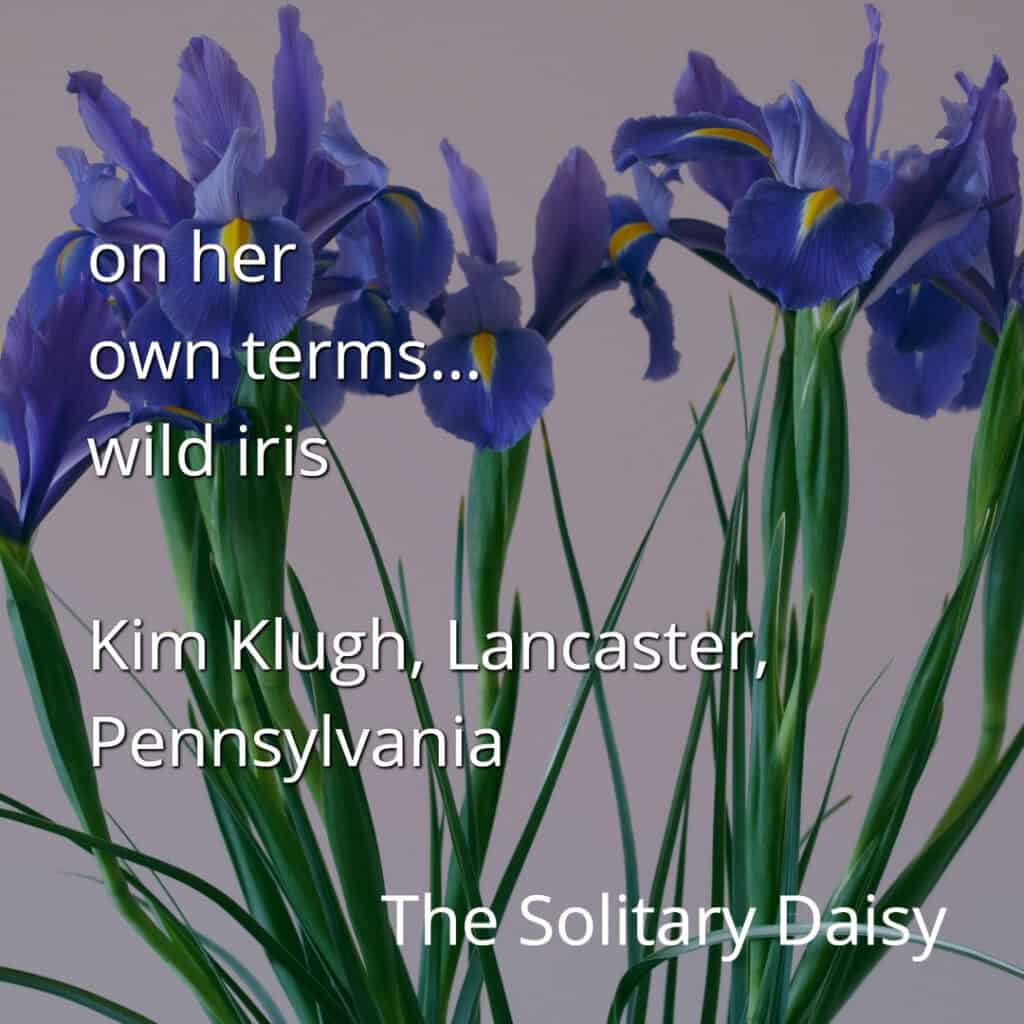
This haiku is quiet, poignant, and deeply atmospheric, using the aftermath of a natural event to evoke loss, resilience, and the uneasy return of normality. Its strength lies in its restraint. Rather than focusing on the violence of the cyclone itself, the poem attends to what comes after, when the world begins to settle but traces of disturbance remain.
The opening phrase, “on her / own terms…,” immediately establishes a human presence, but only indirectly. We know nothing about “her” beyond the suggestion of autonomy. The expression “on her own terms” implies self-determination, resistance to expectation, and a refusal to conform. It often carries the sense of someone living according to their own values rather than those imposed by others. The ellipsis is significant here. Rather than functioning as simple punctuation, it creates a contemplative pause, allowing the phrase to resonate before the final image arrives.
The last line, “wild iris,” reorients the poem. Suddenly, the reader is invited to consider the flower in relation to the opening statement. The adjective “wild” is doing a great deal of work. A cultivated iris grows where it has been planted and tended; a wild iris grows where it chooses—or, more accurately, where nature allows it to flourish. The flower therefore becomes an image of untamed beauty, resilience, and self-possession.
What makes the poem successful is that it never explicitly states that the woman is like the iris. The comparison remains implicit. This is an important distinction. Rather than becoming a metaphor that explains the flower, or a flower that merely illustrates a human trait, the two images exist alongside one another. The reader discovers the relationship rather than having it declared.
There is also an appealing ambiguity surrounding the pronoun “her.” It could refer to a particular woman known to the speaker, someone admired for her independence. Equally, the reader may momentarily attribute the phrase to the iris itself, almost personifying the flower. This slight oscillation between human and plant enriches the poem. The identities briefly overlap without collapsing into one another.
The poem also benefits from what it does not say. We are never told what expectations “she” has resisted, what circumstances she has overcome, or whether her independence has come easily or at great cost. The omission keeps the poem open and prevents it from becoming sentimental or didactic.
One of the poem’s most satisfying qualities is its economy. Every word feels necessary. There is no descriptive padding, no explanation of the iris’s colour or habitat, and no overt emotional cue. The poem trusts both the flower and the reader.
From a haiku perspective, the poem sits interestingly between observation and suggestion. The wild iris is a concrete image rooted in the natural world, yet it is clearly carrying human resonance. Some readers who favour a strictly objective approach to haiku might feel the opening phrase is slightly too interpretive because it attributes a human quality before presenting the image. Others will see this as a fine example of how English-language haiku can allow human and natural worlds to illuminate one another without sacrificing brevity or subtlety.
The ellipsis deserves particular praise. Unlike a dash, which often creates a decisive cut, the ellipsis leaves the thought suspended. It suggests that “on her own terms” is not a conclusion but an ongoing state of being. The pause gives the final image room to bloom, both literally and figuratively.
Overall, this is an elegant and quietly confident haiku. By juxtaposing the phrase “on her own terms” with the image of a wild iris, it evokes independence, dignity, and natural self-expression without ever spelling out its meaning. Like the flower itself, the poem seems unconcerned with pleasing anyone. It simply exists as it is, and in doing so, invites the reader to reflect on the beauty of lives lived according to their own nature.
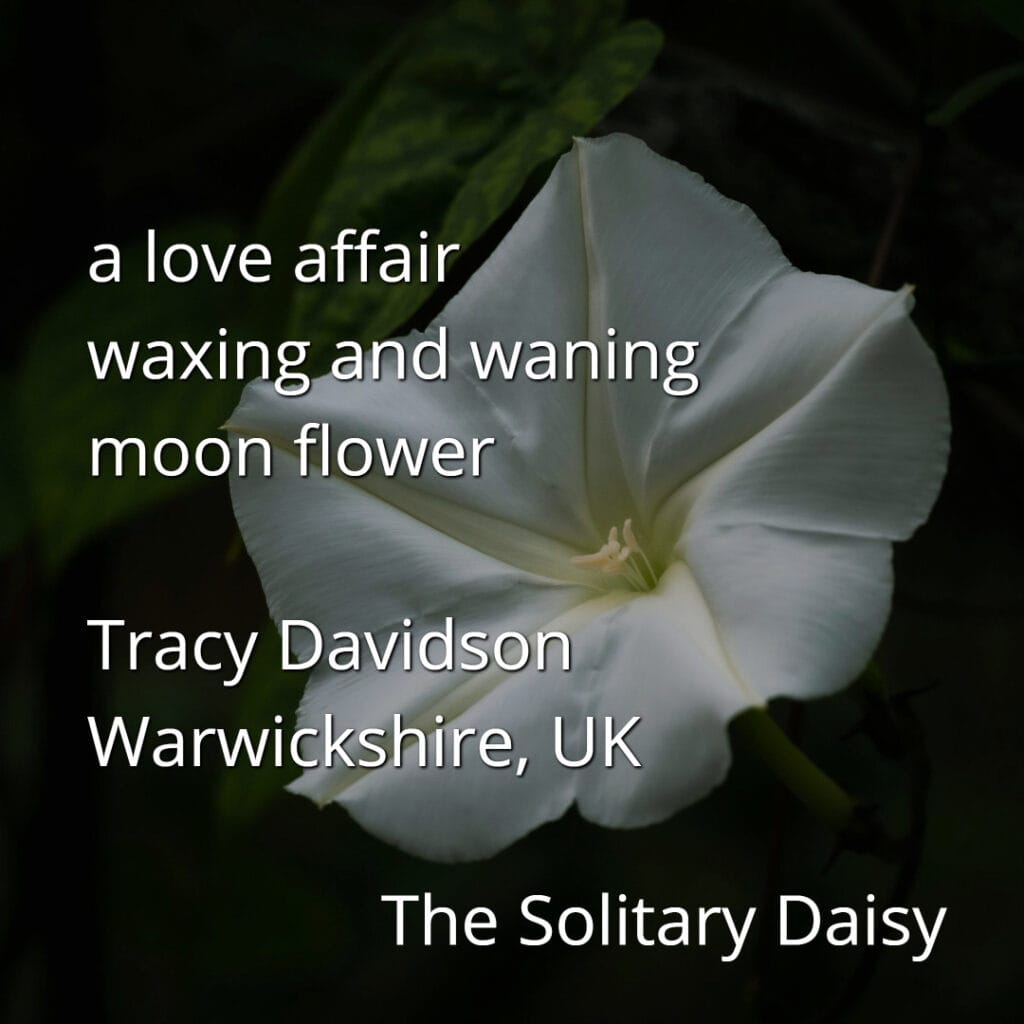
This haiku is elegant in conception, drawing together the lunar cycle and the moonflower into a meditation on the rhythms of love. Although the poem is extremely compressed, it creates a rich field of associations, particularly when read with the cultural symbolism of the moonflower in mind.
The opening phrase, “a love affair,” immediately establishes the poem’s emotional subject. Unlike many haiku, which begin with an image or setting, this poem begins with a human condition. That choice shifts the reader’s attention inward from the outset. The phrase is also intriguingly neutral. A “love affair” can suggest passion, secrecy, infidelity, romance, or simply an intense emotional attachment. The poem wisely refuses to specify which, allowing the reader’s own experiences and assumptions to enter.
The second line, “waxing and waning,” is the poem’s hinge. On the surface, the phrase refers to the changing phases of the moon, but it also functions as an idiom describing fluctuating intensity. Love rarely remains static; it grows, recedes, returns, and changes over time. The poem therefore allows the astronomical and the emotional meanings to coexist naturally.
The final line, “moon flower,” completes the image with considerable subtlety. Without knowledge of its symbolism, the reader encounters a flower whose very name echoes the lunar imagery of the previous line. The poem feels aesthetically complete simply through that connection.
However, the traditional association of the moonflower with hidden or secret love greatly enriches the reading. The poem no longer speaks simply of changing affection, but of a relationship that exists in partial darkness. Moonflowers bloom in the evening and reveal themselves when many other flowers have closed, making them an apt emblem for love that flourishes away from public view. Read this way, the waxing and waning become not merely emotional fluctuations but the changing visibility of the affair itself—moments when it emerges into light, followed by periods of concealment.
This interplay between the moon’s phases and the flower’s symbolism is the poem’s greatest strength. The moon is never mentioned directly, yet it is present through the phrase “waxing and waning” and again through the flower’s name. The imagery feels unified rather than layered on.
There is also a pleasing ambiguity in the structure. Grammatically, one can read “moon flower” as the object of the preceding phrase, or as an independent image that quietly reframes everything that came before. This openness encourages the reader to linger.
That said, the poem leans more heavily on symbolic association than direct sensory observation. Traditional haiku often derive their emotional force from concrete moments in the physical world, allowing meaning to emerge indirectly. Here, all three components—love affair, waxing and waning, and moonflower—carry symbolic weight. The result is a poem that feels closer to lyric compression than to pure observation. Whether this is a weakness depends largely on one’s understanding of haiku. Many contemporary English-language poets would welcome this degree of symbolic interplay, while more orthodox readers might wish for a more immediate experiential anchor.
The omission of an article before “moon flower” is also effective. The final line feels less like the naming of a particular blossom than the arrival of an archetypal image. It has the quality of an emblem, quietly gathering together the emotional movement of the preceding lines.
There is another possible reading worth considering. Because waxing and waning are cyclical rather than terminal, the poem resists presenting love as either permanently growing or permanently fading. Instead, it suggests recurrence. Especially in the context of a hidden affair, this feels psychologically true. Such relationships often exist in rhythms of closeness and distance, revelation and concealment, desire and restraint. The lunar imagery captures this cyclical quality beautifully.
Overall, this is a thoughtful and resonant haiku whose imagery is strengthened considerably by the cultural symbolism of the moonflower. The poem links the changing phases of the moon with the changing fortunes of a love affair, while the moonflower quietly introduces the additional dimension of secrecy and hidden longing. The result is a work that feels less like a narrative than an emotional constellation, where each image reflects and deepens the others. It is a poem of suggestion rather than declaration, inviting the reader to inhabit the shifting light and shadow of love itself.
Just For Fun
Haiku Girl Summer is now accepting submissions! This year, in addition to the haiku/senryu submissions, there will be a special haiga week. Haiga submissions are due by July 19th. Final submissions for haiku/senryu is August 15th.
The Haiku Shack Anthology is a new series curated and edited by Cendrine Marrouat and Sherri J Moye-Dombrosky. Each volume will contain a maximum of 50 haiku selected from contributors living around the world. Submissions for the upcoming issue must be in by September 30th.
Tsuri-dōrō will open for submissions for their Fall issue from July 1st to 10th. They are looking for both haiku and haiga. Please read the submission guidelines carefully.
Drifting Sands Haibun Journal is open from submissions until July 15th. This journal accepts haibun and tanka only.
Charlotte Digregorio seeks senryu to appear on her blog on “The Daily Haiku”. Submitted senryu may be either unpublished or previously published with publication credit. (If unpublished, it may be edited for clarity.) Please submit JUST ONE SENRYU by July 20th to c-books@hotmail.com.
The Wales Haiku Journal invites you to celebrate summer with them through the meditative art of haiku. Traditional, experimental, monoku, and senryu are all welcome. The deadline for submissions is July 31st.
Café Haiku is open for submissions of micro haibun. You may send up to five, 50 word haibun (including title, prose, and haiku!). Deadline is July 31st.
Have a little extra time this summer? Check out these great resources, compiled by the Haiku Society of America! Link here.
A project that Sally and Michele are working on currently is a Canadian kigo (season word) book with room to write your own haiku. Won’t it be nice to share more Canada with the world! Canadians are welcome to send in suggestions to Michele at kelownalady@hotmail.com with the subject line “Canadian Kigo.”
This Week’s Prompt
Our next issue will be another special one for people who have not had a haiku published with us in the past. Please send one or two haiku by Sunday, July 26th. We ask that you check our submission details carefully on our website.
Send one or two haiku to sally_quon@yahoo.com or to Michele at kelownalady@hotmail.com. Find our full submission info here. Don’t forget to tell us where you are writing from!
“A perfect summer day is when the sun is shining, the breeze is blowing, the birds are singing, and the lawn mower is broken.”
― James Dent

SB Wright (Seàn Wright) is a disabled poet living in the South Australian Mid-North. Born in Nhulunbuy in Arnhem Land, he spent most of his life in Alice Springs before relocating south. A graduate of NTU, his working life has ranged widely, including roles as a security guard, martial arts instructor, trainer for an international gaming company, teacher librarian, and primary school teacher. In 2024, he became disabled due to AL Amyloidosis.
Japan and Japanese culture have been lifelong interests. While his poetry ranges from formal to free verse within the Western tradition, Japanese poetry and its English-language offshoots hold a special place in his work. His poems have been published in Verity La, Tincture Journal, Eureka Street, A Hundred Gourdes, INDaily Adelaide, Folk Ku Journal, and the anthologies The Stars Like Sand and 50 Haikus. His first collection of poetry (including Haiku and Haibun is Magpie Tales through Close-Up Books.
h.

Michele Rule is a disabled writer from Kelowna BC. She is especially interested in the topics of chronic illness, relationships and nature. Michele is published in the Asahi Shimbun Haikuist, Pine Cone Review, the Enchanted Garden, Five Minute Lit, Shadow Pond, WordCityLit, and the anthologies F*ck the Patriarchy, Chicken Soup for the Soul, and To Live Here, among others. She is an associate member of the League of Canadian Poets and Haiku Canada. Michele has been awarded honourable mention twice for the Vancouver Cherry Blossom Festival Haiku Invitational and also for the Haiku Northwest Porad Award. Her first chapbook is Around the World in Fifteen Haiku. Michele lives in a beautiful garden surrounded by people who love her just the way she is.

Sally Quon is a disabled poet and photographer living in the Okanagan Valley of beautiful British Columbia, Canada. She is an associate member of The League of Canadian Poets and a member of Haiku Canada. Her work has been published in numerous journals including The Heron’s Nest, Modern Haiku, Frogpond, First Frost, and Time Haiku. She is currently working on her first book of haiku, haibun, and haiga, tentatively titled, “My Valley, My Home.”
Featherstone Creative