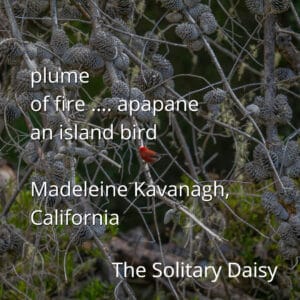
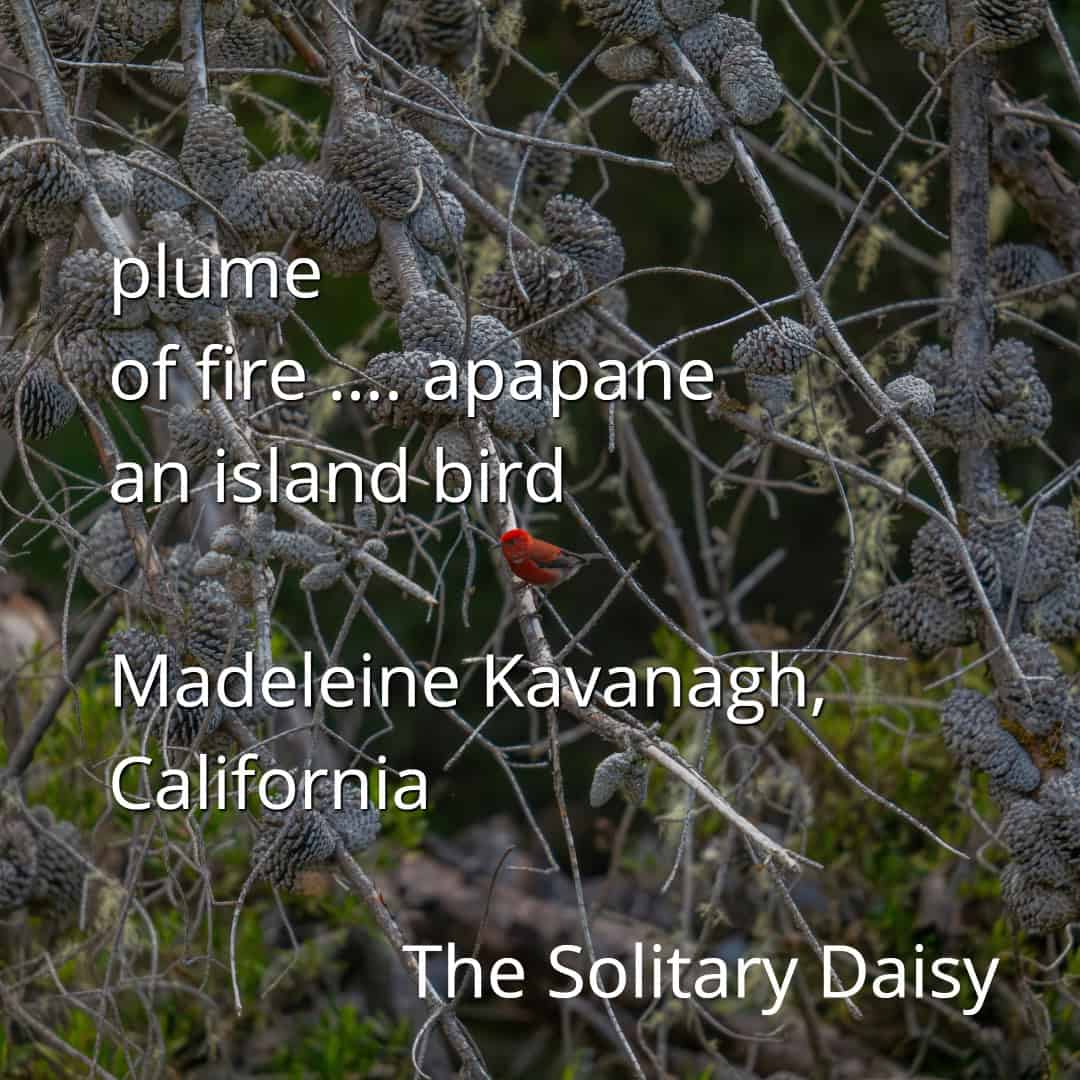
plume
of fire …. apapane
an island bird
Madeleine Kavanagh, California
one rose
sails unfurled
in a sea of buds
Liz Kornelsen, Winnipeg MB
moonlamps —
the flow of a fluther
island-blooming
after ‘reef aquarium’ by Miko San
Sheikha A., Dubai, United Arab Emirates
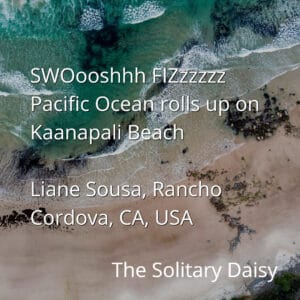
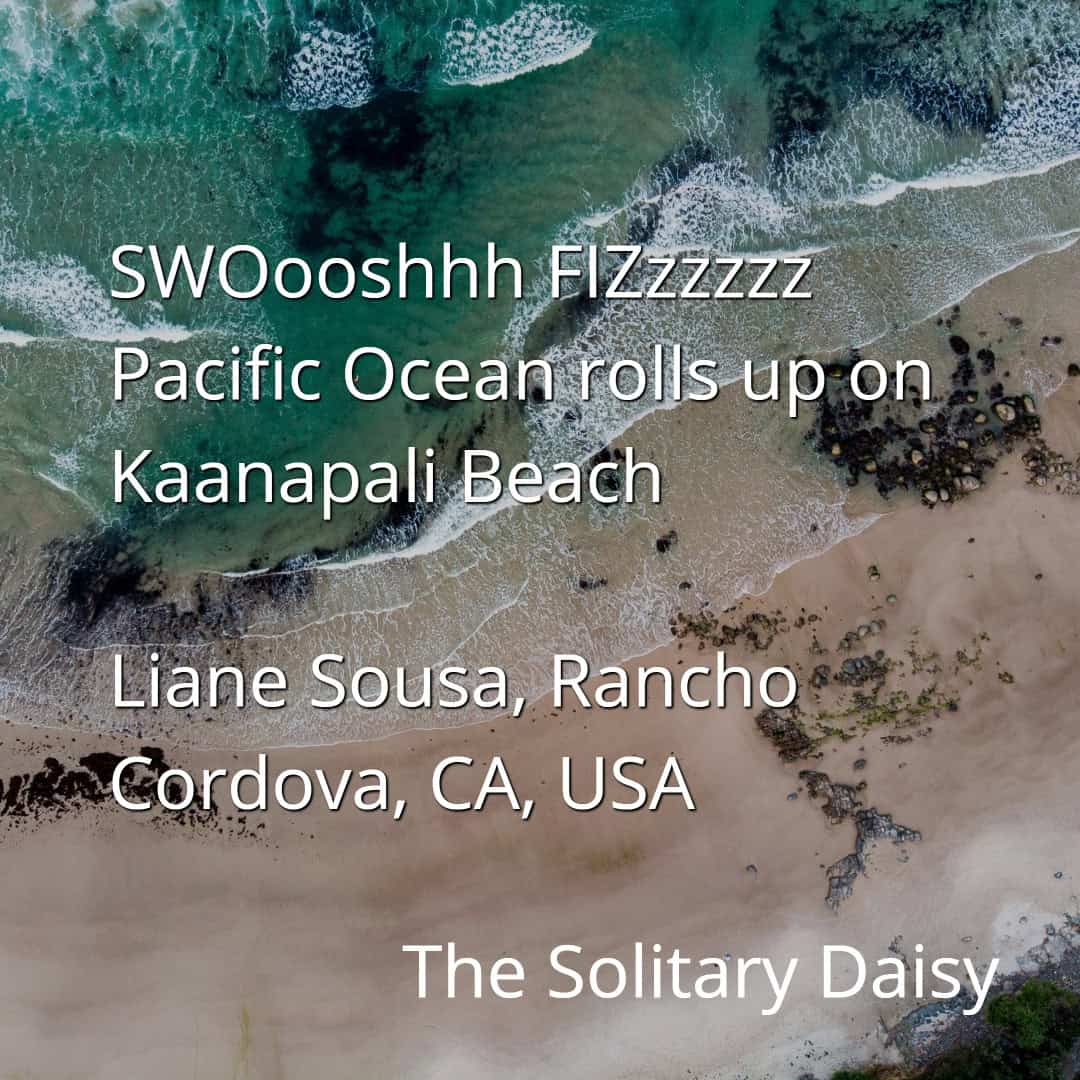
SWOooshhh FIZzzzzz
Pacific Ocean rolls up on
Kaanapali Beach
Liane Sousa, Rancho Cordova, CA, USA
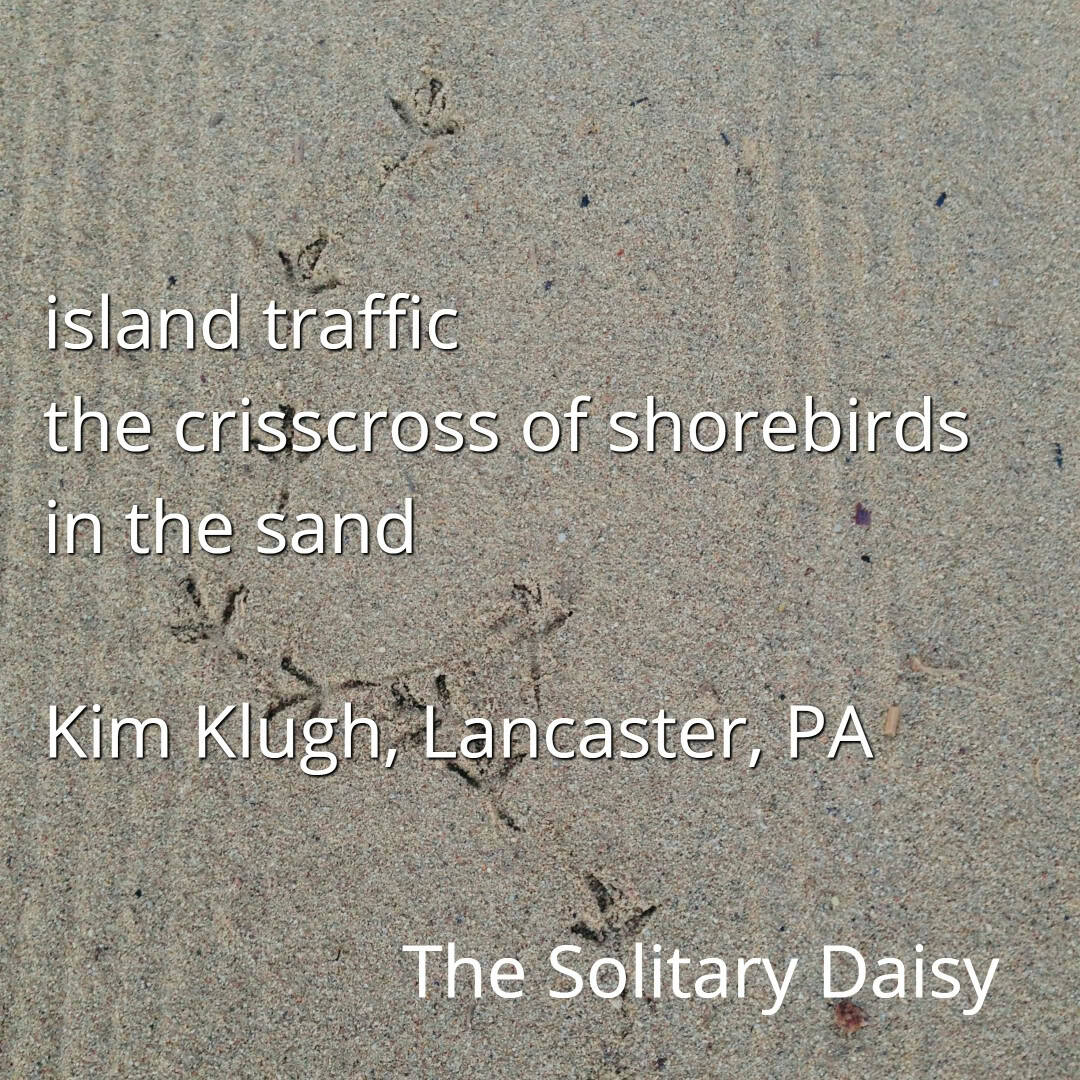
island traffic
the crisscross of shorebirds
in the sand
Kim Klugh, Lancaster, PA
no rooftop
higher than the palm trees –
island sunset
Lisa Billa, San Jose, California
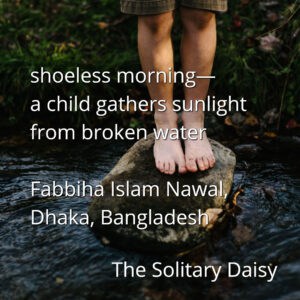
after the cyclone—
the tide returning softly
to an empty swing
Fabbiha Islam Nawal, Dhaka, Bangladesh
rose-scented foam
and the island of
her pregnant belly
Urszula Marciniak, Poland, Łódź
this distance
separating us
isthmus
Louise Hopewell, Australia
a dream—and yet
the Milky Way arches toward
Formosa
Note: In 1544, Portuguese sailors sighted Taiwan and named it Ilha Formosa — “Beautiful Island.”
Chen-ou Liu, Ajax, Ontario, Canada





Michele’s Musings
Dear friends,
Sally and I have been so busy this past week as we hosted a writers’ retreat for a weekend in the tiny community of Rock Creek! Frithjof was our chief cook and bottle washer (thank goodness for the dishwasher!) so we were spoiled with all kinds of fresh baking and healthy meals. We had a full itinerary of writing exercises, but sometimes skipped the writing just to visit and get to know each other better. We attempted a haiku happy hour and were pleased to be able to teach haiku to some total newcomers!
Then we came home and turned our attention to Sally’s birthday party! She hasn’t had a party since she was twelve and she turned 60 on June 3rd, so it seemed like it was time to celebrate this wonderful woman! The weather was windy and rainy with occasional thunder as we headed out to Bertram Creek Park, but when we arrived it wasn’t even drizzling anymore. The picnic tables were under cover, everyone brought salad or dessert, and Frithjof cooked hot dogs.
one more slice of cake
marking next year’s date
in my calendar
We hope you have all been enjoying our calendar of prompts for June thus far! We are looking forward to reading how you interpreted and reacted to the prompts or any other summer season words.
Keep on writing!
Member News
I’m honored to have a ku included in the new
CORNFLOWER HAIKU MAGAZINE!
You shared their link recently. It’s a lovely collection and a stunning first edition!
trailing silk
the weaver begins
spinning sunlight
Belinda Behne CT, USA
—
I have just been accepted in Echidna Tracks for the first time as they are now open to international writers.
Joanna Ashwell, UK
—
Chapbook launch – honesty slips by kjmunro
kjmunro has a new chapbook called honesty slips (Turret House Press,
Montreal, 2026) – a combination of haiku & longer poems. The official launch
by Turret House Press will be 19 August 2026 in Montreal. A local launch will take place in Whitehorse on Saturday 30 May, from 2-4 pm. Readings will start at 2:30pm with special guest Nicole Bauberger at DECORA, 7 Roundel Road, Whitehorse, Yukon Territory.
For more information, & to order copies, please contact Turret House Press (https://turrethousepress.ca/) or kjmunro via her website: kjmunro1560.wordpress.com
In the Whitespace with Sean
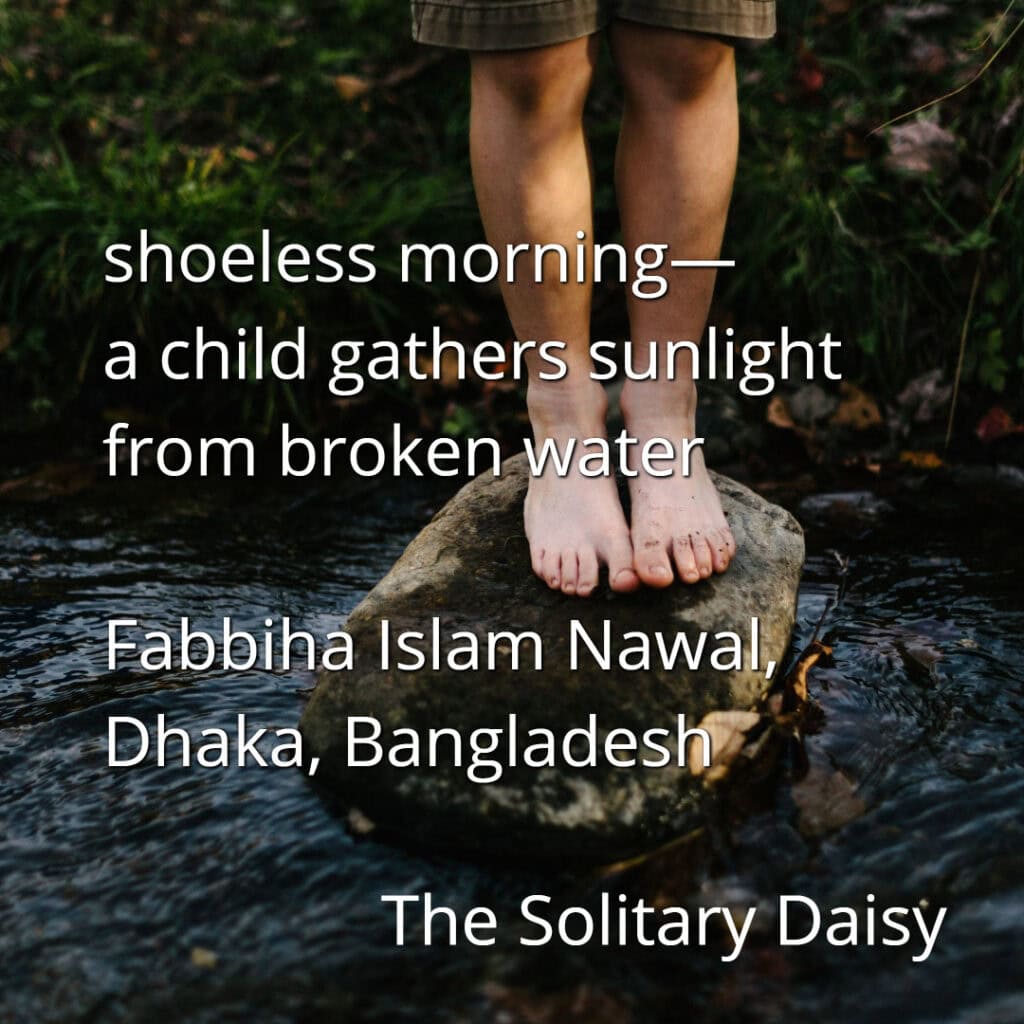
This haiku is quiet, poignant, and deeply atmospheric, using the aftermath of a natural event to evoke loss, resilience, and the uneasy return of normality. Its strength lies in its restraint. Rather than focusing on the violence of the cyclone itself, the poem attends to what comes after, when the world begins to settle but traces of disturbance remain.
The opening phrase, “after the cyclone—,” immediately places the reader in a landscape marked by upheaval. Cyclones carry associations of destruction, displacement, fear, and immense natural force. Yet the poem does not depict the storm directly. By beginning with its aftermath, it directs attention toward recovery, memory, and the altered emotional landscape left behind. The dash creates a pause that allows the magnitude of the event to linger before the quieter image emerges.
The second line, “the tide returning softly,” introduces a striking contrast. Where the cyclone was violent and overwhelming, the tide returns with gentleness and regularity. The sea resumes its ancient rhythm as though continuing a process interrupted but not fundamentally changed. The word “softly” is particularly important. It tempers the memory of violence and creates an atmosphere of calm, but it also carries a faint sense of tenderness, as if the world is cautiously reassembling itself.
The final line, “to an empty swing,” provides the poem’s emotional centre. The swing is a powerful object because it is so strongly associated with human presence, especially childhood, play, and community. Its emptiness immediately raises questions. Has the swing simply been abandoned after the storm? Has someone left? Has something been lost? The poem wisely refuses to answer. The swing becomes a vessel for absence rather than a symbol with a fixed meaning.
What makes the image especially effective is the relationship between the tide and the swing. The tide is dynamic, cyclical, and returning. The swing is motionless and empty. One suggests continuity; the other suggests interruption. Together they create a subtle tension between nature’s capacity to recover and the more uncertain recovery of human lives.
There is also an emotional ambiguity that gives the poem depth. The returning tide could be read as reassuring, evidence that life continues after catastrophe. At the same time, its softness may heighten the poignancy of the empty swing, drawing attention to what has not returned. The poem balances consolation and sadness without committing entirely to either.
The sound and rhythm contribute to the atmosphere beautifully. The long vowels and soft consonants of “tide returning softly” slow the poem and create a gentle ebbing movement that mirrors the action being described. This makes the final image of the empty swing feel even more still and isolated.
One particularly compelling aspect of the poem is its refusal to dramatise. A lesser poem might focus on destruction, debris, or overt grief. Instead, this haiku finds its emotional power in a single ordinary object encountered after the event. That choice allows the reader to feel the storm’s consequences indirectly, which often proves more affecting than explicit description.
Overall, this is a moving and finely controlled haiku that explores the aftermath of disaster through contrast and implication. By setting the soft return of the tide against the image of an empty swing, the poem captures the complex emotional territory between recovery and loss, reminding us that while nature resumes its rhythms, some absences remain unresolved.

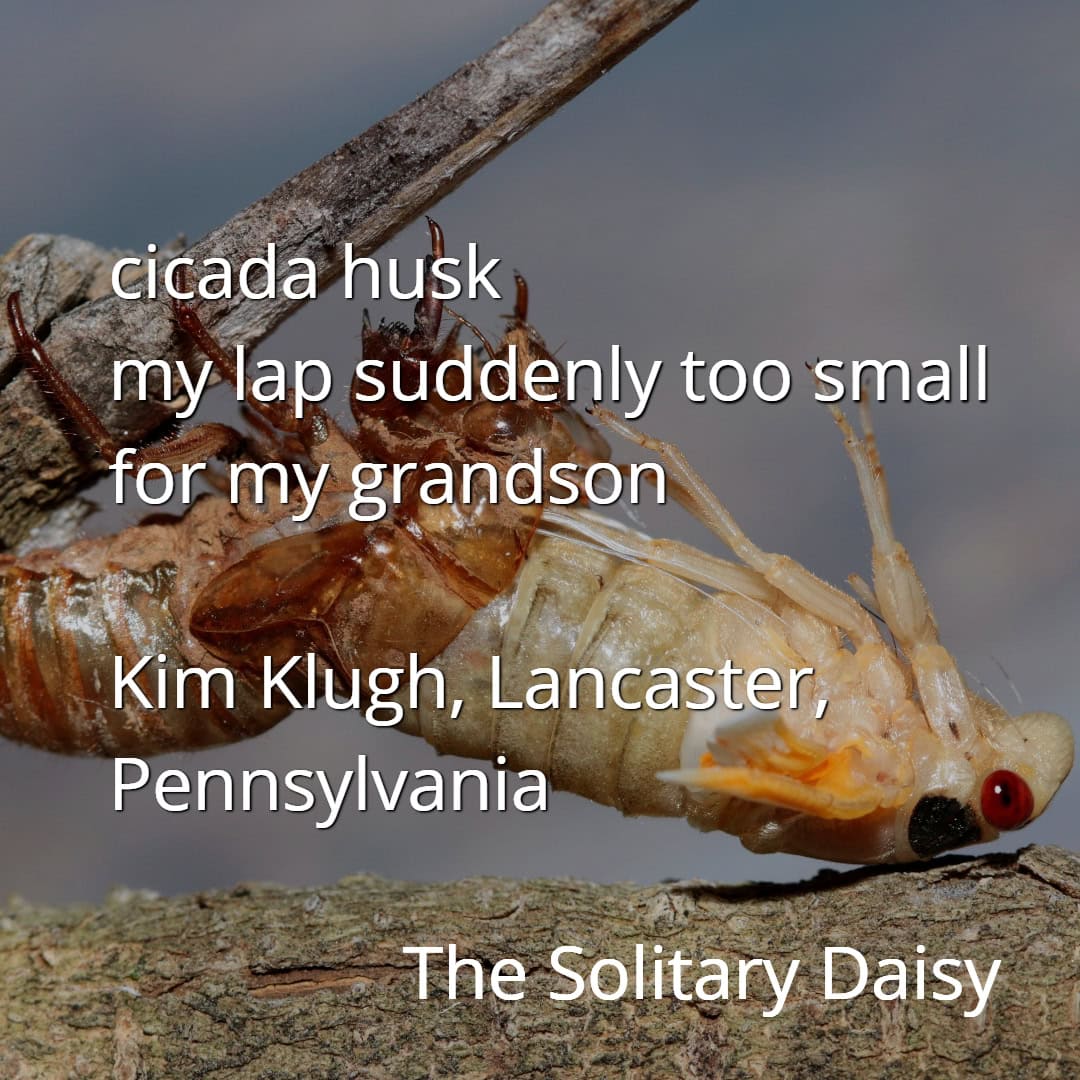
This haiku is tender, poignant, and beautifully grounded in a moment of seasonal observation that opens into an awareness of time passing. Its strength lies in the
way the natural image and the human realization illuminate one another without forcing a symbolic connection.
The opening phrase, “cicada husk,” immediately establishes a strong seasonal presence. A cicada shell is the discarded exoskeleton left behind after transformation, and it naturally evokes growth, emergence, and the passage from one stage of life to another. It is a familiar image of change, but the poem handles it with enough restraint that it never feels merely symbolic. The husk remains a real object in the world before it becomes anything more.
The second line, “my lap suddenly too small,” introduces a moment of realization that feels both physical and emotional. The word “suddenly” is particularly effective because the growth itself has not happened suddenly at all. The grandson has been growing continuously, but the speaker’s recognition of that growth arrives in a single instant. Many readers will recognise this phenomenon: gradual change becoming visible all at once.
The final line, “for my grandson,” completes the emotional movement with remarkable simplicity. The poem never explicitly mentions aging, childhood, or the passage of years. Instead, it allows the shrinking suitability of the lap to convey all of these things indirectly. What was once a place of comfort, protection, and closeness can no longer accommodate the growing child.
The relationship between the cicada husk and the grandson is handled especially well because it is based on shared transformation rather than direct metaphor. The poem does not suggest that the grandson is the cicada or that the lap is the husk.
Rather, both images participate in the same awareness of growth and change. The discarded shell becomes an external echo of the speaker’s recognition that childhood itself is being shed.
There is also a subtle emotional complexity here. The realization carries pride, because growth is natural and welcome, but it also carries loss. The lap becoming “too small” marks the end of a particular kind of intimacy. The poem captures that bittersweet mixture without sentimentality. It neither celebrates nor mourns outright, instead allowing both feelings to coexist.
The physicality of the image contributes greatly to its effectiveness. The lap is not an abstract symbol but a lived space of caregiving and affection. Because the realization is embodied, the emotional impact feels earned rather than stated.
The pacing is also excellent. The poem moves from the stillness of the cicada husk to the sudden recognition of change, and finally to the specific relationship that gives the moment its emotional weight. Each line expands the significance of the one before it.
One could even argue that the cicada husk introduces another subtle layer. A husk is evidence of a creature no longer fitting its former shape. Likewise, the grandson no longer fits within the physical and emotional dimensions of early childhood.
The parallel is gentle enough that it enriches the poem without becoming overly interpretive. Overall, this is a moving and accomplished haiku that captures a universal experience through concrete imagery and understatement. By juxtaposing a cicada husk with the realization that a grandson has outgrown a grandparent’s lap, the poem evokes growth, love, and the bittersweet awareness that life’s transformations often become visible only when they have already occurred.
Just For Fun
As Words Fly – The Bougainvillea Journal is accepting submissions of haiku, senryu, tanka, or micropoetry until June 10th. Please use a kigo related to the season of monsoon or summer.
Submissions for Post-ku are open now until June 15th. This unique offering is a series of monthly postcards featuring the grey area between free-verse micropoetry and conventional haiku.
Haiku Girl Summer is now accepting submissions! This year, in addition to the haiku/senryu submissions, there will be a special haiga week. Haiga submissions are due by July 19th. Final submissions for haiku/senryu is August 15th.
The International EJCA Spring Haiku Contest is open until June 20th. There are a number of categories to enter under. Remember, the overall theme is spring and you should use a spring season word.
The Triveni Haiku Awards, out of India, are open for submissions from June 10th to June 30th. This annual competition welcomes submissions from international writers. This year’s judges are Billie Dee and Vandana Parashar.
The Haiku Shack Anthology is a new series curated and edited by Cendrine Marrouat and Sherri J Moye-Dombrosky. Each volume will contain a maximum of 50 haiku selected from contributors living around the world. Submissions for the upcoming issue must be in by September 30th.
The 2026 Marlene Mountain Haiku Contest, hosted by #FemkuMag, will be open June 1st to 15th. This contest has a theme of “one-line haiku or senryu” and is open to women, transgender, nonbinary, and gender-expansive poets.
Hexapod Haiku Challenge is now open! In addition to the usual age-related award categories, they will offer a special topic award this year for the best haiku featuring arthropod recyclers. Deadline for submissions is June 15th.
Haiku Journal is open for submissions on a rolling basis. They accept strictly haiku in the 5-7-5 format. In addition, each line cannot surpass 40 characters due to printing requirements.
Kokako, a Japanese short-form journal out of New Zealand, is accepting submissions until July 1st. You can read the interesting story of the journal’s name on their about page.
This Week’s Prompt
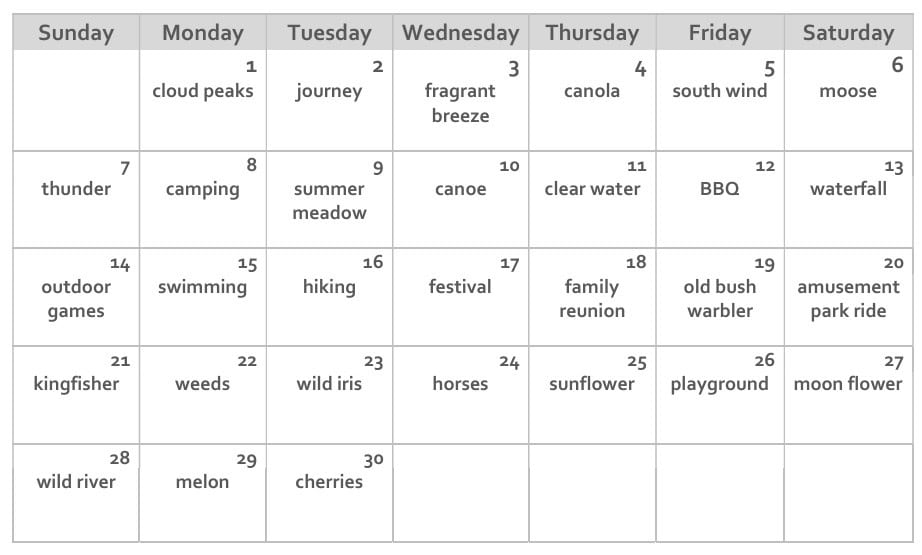
Download your copy of the calendar!
Send us one or two haiku based on the month of summer prompts or any other summer seasonal references. Deadline for submissions is June 14th.
Send one or two haiku to sally_quon@yahoo.com or to Michele at kelownalady@hotmail.com. Find our full submission info here. Don’t forget to tell us where you are writing from!
“Friends are the sunshine of life.”
― John Hay

SB Wright (Seàn Wright) is a disabled poet living in the South Australian Mid-North. Born in Nhulunbuy in Arnhem Land, he spent most of his life in Alice Springs before relocating south. A graduate of NTU, his working life has ranged widely, including roles as a security guard, martial arts instructor, trainer for an international gaming company, teacher librarian, and primary school teacher. In 2024, he became disabled due to AL Amyloidosis.
Japan and Japanese culture have been lifelong interests. While his poetry ranges from formal to free verse within the Western tradition, Japanese poetry and its English-language offshoots hold a special place in his work. His poems have been published in Verity La, Tincture Journal, Eureka Street, A Hundred Gourdes, INDaily Adelaide, Folk Ku Journal, and the anthologies The Stars Like Sand and 50 Haikus. His first collection of poetry (including Haiku and Haibun is Magpie Tales through Close-Up Books.
h.

Michele Rule is a disabled writer from Kelowna BC. She is especially interested in the topics of chronic illness, relationships and nature. Michele is published in the Asahi Shimbun Haikuist, Pine Cone Review, the Enchanted Garden, Five Minute Lit, Shadow Pond, WordCityLit, and the anthologies F*ck the Patriarchy, Chicken Soup for the Soul, and To Live Here, among others. She is an associate member of the League of Canadian Poets and Haiku Canada. Michele has been awarded honourable mention twice for the Vancouver Cherry Blossom Festival Haiku Invitational and also for the Haiku Northwest Porad Award. Her first chapbook is Around the World in Fifteen Haiku. Michele lives in a beautiful garden surrounded by people who love her just the way she is.

Sally Quon is a disabled poet and photographer living in the Okanagan Valley of beautiful British Columbia, Canada. She is an associate member of The League of Canadian Poets and a member of Haiku Canada. Her work has been published in numerous journals including The Heron’s Nest, Modern Haiku, Frogpond, First Frost, and Time Haiku. She is currently working on her first book of haiku, haibun, and haiga, tentatively titled, “My Valley, My Home.”
Featherstone Creative