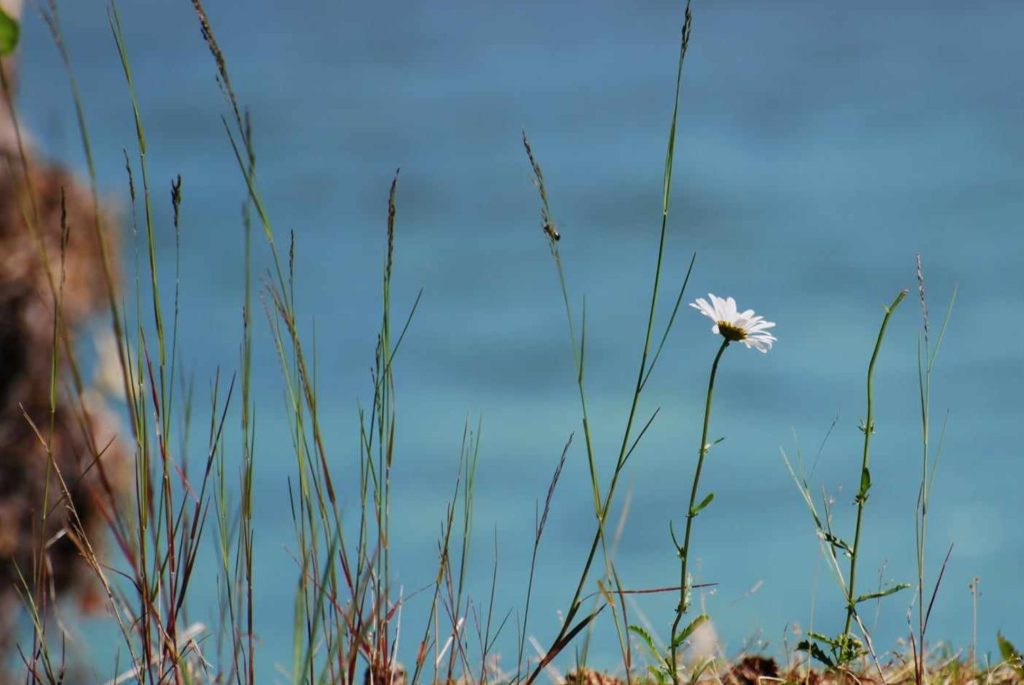
season’s end
a goalkeeper catches
sunlight
Hynek Koziol
Czech Republic
twilight hues
in the folds of her hands
cherry blossoms
Bhawana Rathore
India
thin ice
the weight of sky
in every step
C.X. Turner
Birmingham, U.K
winter afternoon
daffodils blooming...
in the jigsaw puzzle
Kim Klugh
Lancaster, Pennsylvania
groundhog day
I never liked that movie
I never liked that movie
Tracy Davidson
Warwickshire, UK
milk teeth
in time with spring
— snowdrops
Sheikha A.
Dubai United Arab Emirates
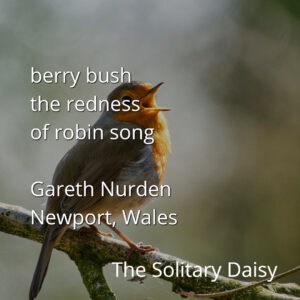
berry bush
the redness
of robin song
Gareth Nurden
Newport, Wales
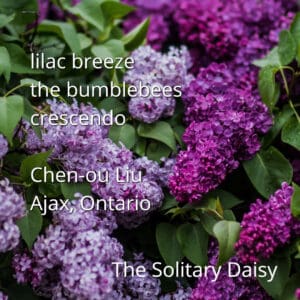
lilac breeze
the bumblebees
crescendo
Chen-ou Liu
Ajax, Ontario
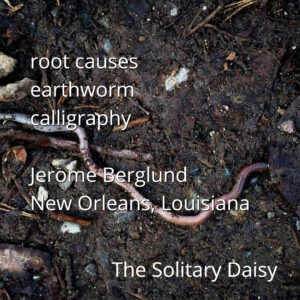
root causes
earthworm
calligraphy
Jerome Berglund
New Orleans, Louisiana

Michele’s Musings
Hello friends!
It looks like so many of you are enjoying the prompts in the Haiku Month calendar! We certainly enjoyed your submissions thus far! This issue’s prompt will ask for another round from you, so keep on writing!
I’m really pleased to announce that we have a new team member here at the Solitary Daisy! Join me in welcoming Sean Wright. Sean and I met through Bluesky, where both he and the Solitary Daisy have accounts. Sean writes a blog on Substack dedicated to haiku and he will be writing for us once a month or so, providing commentary on one of your haiku to help us all get a better idea of how to read and write haiku.
Speaking of Bluesky, I ran a little senryu competition over there last week. I would like to share these two outstanding senryu.
Amazon profits
the dark grey tinge
of malnutrition
Alan Summers (thehaikutec.bsky.social)
black ice
a murder of crows lands
in minnesota
John Hawkhead (haikuhawk.bsky.social)
Find more tremendous senryu in the post on Bluesky!
Finally, I couldn’t resist sharing this haiku sent in by Merilee Johnson:
no bike built for two
on the seat I’ll be
a solitary Daisy
Merilee Johnson
New York, NY
Keep on writing!
In the Whitespace with Sean

season’s end
a goalkeeper catches
sunlight
Hynek Koziol
Czech Republic
This is a poised, quietly cinematic haiku that captures a fleeting convergence of time, body, and light. “season’s end” carries layered meaning. It could refer to the end of spring, and the presence of a goalkeeper also signals the end of a sporting season. That double register gives the opening line depth without explanation. It feels both literal and elegiac.
The poem hinges on a single visual instant: “a goalkeeper catches / sunlight.” The verb “catches” is doing elegant work. It belongs naturally to the sport, yet here the object is intangible. The perception feels spontaneous — a gloved reach intersecting a low, late sun.
The pairing of seasonal time with a fleeting sensory moment (sunlight caught mid-air) creates quiet poignancy. Seasons end; light slips away; careers close. None of this is stated, but the image allows it.
The hard consonants in “goalkeeper catches” give physicality and weight, while “sunlight” softens the ending. The poem moves from abstraction (season) to action (catches) to radiance (sunlight), narrowing toward a single luminous image.
Importantly, the poem does not sentimentalize the moment. It doesn’t tell us whether the catch is successful or symbolic. It simply shows the convergence of body and light.
A strong contemporary haiku that balances athletic realism with quiet transcendence. It captures not just a play on the field, but a moment when time itself seems briefly held.
Member News
Last month, I attended an on-line workshop put on by Angela Leuck of Haiku Canada on creating your own haiku chapbooks. The workshop was fantastic and offered many tips and suggestions for adding some real creative touches to your project. I love the idea of creating a chapbook with such a hands-on approach. Too often we focus on getting published and forget about the joy of creating.
Naturally, when something excites me, I have to drag Michele into it, and to my delight, she’s almost always down. She did put a kibosh on skinny-dipping in the lake, though.
Anyway, we met at her house this week and began the process of creating our own chapbooks. Somehow, over the course of two hours, we only managed the first couple of steps – too much conversation and laughter – but it’s a start! We’ll keep you posted on our progress.
Michele recently submitted a haiku in response to a Poetry Pea video prompt on YouTube. She was very pleased to have that haiku included in Poetry Pea Journal 5:25.
dancing feet
the red and yellow swirl
of poppies
Please remember to send us your news. We want to celebrate you and the joy of haiku.
Send your news to sally_quon@yahoo.com or kelownalady@gmail.com
Can’t wait to hear from you!
Sally’s Notebook
I have a confession to make. I wrote less than 20 haiku in all of 2025. There is a very long, complicated reason for this, which I won’t go into here, but suffice to say I’ve been talking the talk, without walking the walk. This year, things are changing.
Of course, it started in Oyama with Haiku Happy Hour, but there were also brain-storming sessions for both the NaHaiWriMo Calendar and other haiku projects Michele and I want to tackle.
We spitballed ideas for the calendar prompts which Michele faithfully recorded while I just let them slip right back out of my head. I didn’t even see the full calendar until Frithjof and Michele put it into the Daisy, and I have been refusing to look ahead, writing to each prompt on the daily.
The problem with writing haiku, like any other form of writing, is how important the practice of writing haiku is to the writing of good haiku. My haiku muscles are in a state of atrophy.
Normally, the go-to for haiku inspiration is to read haiku. For traditional haiku, I enjoy reading Issa and Basho. For modern haiku, I’ve always turned to The Haiku Anthology (Cor Van Den Heuvel, Editor) and Haiku Moment (Bruce Ross, Editor).
But even as my own early attempts at haiku now make me cringe, I’m finding those two volumes are starting to feel a bit dated.
I am continually blown away by the quality of haiku being submitted to The Solitary Daisy. I don’t understand the mechanics of a good haiku the same way our new columnist, Sean Wright, does, but I know, when I’m reading your submissions what makes me go, “Oh, OH!”
It’s you, the haiku writers of today, who inspire me and make me want to write better haiku. While Haiku Moment and The Haiku Anthology will always have a special place in my heart and on my bookshelf, now, when I want to be inspired, I go to where I can find you, online in places like The Heron’s Nest, or here, in my emails, when I get to see what marvelous writing you share, what pieces move me, often to tears like this one:
twilight hues
in the folds of her hands
cherry blossoms
Bhawana Rathore, India
Often, people will say in their submissions, “Thank you for all you do for haiku.”
But now it’s my turn.
Thank you. For all you do for haiku. I am grateful.
Places to submit
Frontier Poetry is holding the 2026 (NOT) in Love haiku challenge from February 5th to 15th! Send poems that celebrate the people, places, memories, and things we love to hate.
Only Human, an English senryu, kyoka, and senbun journal, is now open for submissions for its first issue! Deadline is February 28th.
The 37th ITO EN Oi Ocha Shonhaiku Contest is open for submissions until February 28th. 1000 winning haiku will be published on bottles of Oi Ocha!
Poetry Pea is accepting submissions of haiku and senryu in three-line format from February 1st until 15th. They will also have a fun Video Prompt submission period from February 1st to 28th on their YouTube channel!
Haiku Shack is open for submissions on the theme of water. Final deadline is February 28th, but only 50 pieces are chosen so be sure to submit early.
The World Parkinson Coalition Poetry Project invites the submission of poetry, including haiku, in celebration of the 7th Annual World Parkinson Congress. Deadline is February 28th.
Do you write haiku in French? The Haiku Canada Prix Jocelyne-Villeneuve is open for submissions of French haiku only until February 28th.
Haiku Canada’s Betty Drevniok Award for 2026 opens December 15th and runs until February 28th. Find the submission form here.
Prune Juice is open for traditional senryu as well as innovative/experimental senryu. The theme for this issue is sex, drugs, and rock and roll! Deadline is February 28th.
Literary Revelations is working on a new anthology titled Haiku for Soulmates! If you have a soulmate, please compose five haiku for him or her. If you do not, let your imagination shape five haiku that describe the soulmate you hope to meet. Deadline is February 25th.
The Haiku Foundation has an interesting program on right now called Haiga for Healing. The idea is to look at a photo and see how it relates to whatever needs healing in your life, then share the haiku that you write below. Check it out!
Call of the Page is opening up a number of courses including Tiny Haibun. These fill up incredibly fast, so hopefully there will be some spots left. Otherwise sign up to the mailing list so you get earlier notification of the next semester.
This Week’s Prompt
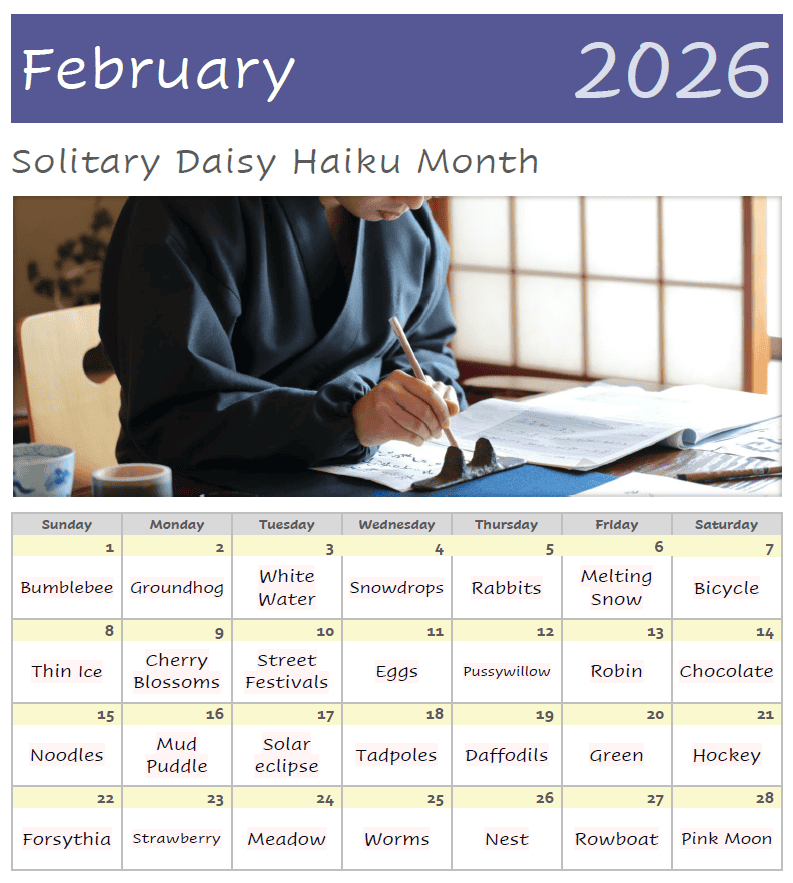
Looking at the prompts for Haiku Month, pick one or two and send in two haiku!
The deadline for submissions will be Sunday, February 22nd.
Send one or two haiku to sally_quon@yahoo.com or to Michele at kelownalady@hotmail.com. Find our full submission info here. Don’t forget to tell us where you are writing from!
“I go among the trees and sit still.”
— Wendell Berry

SB Wright (Seàn Wright) is a disabled poet living in the South Australian Mid-North. Born in Nhulunbuy in Arnhem Land, he spent most of his life in Alice Springs before relocating south. A graduate of NTU, his working life has ranged widely, including roles as a security guard, martial arts instructor, trainer for an international gaming company, teacher librarian, and primary school teacher. In 2024, he became disabled due to AL Amyloidosis.
Japan and Japanese culture have been lifelong interests. While his poetry ranges from formal to free verse within the Western tradition, Japanese poetry and its English-language offshoots hold a special place in his work. His poems have been published in Verity La, Tincture Journal, Eureka Street, A Hundred Gourdes, INDaily Adelaide, Folk Ku Journal, and the anthologies The Stars Like Sand and 50 Haikus. His first collection of poetry (including Haiku and Haibun is Magpie Tales through Close-Up Books.
h.

Sally Quon is a disabled poet and photographer living in the Okanagan Valley of beautiful British Columbia, Canada. She is an associate member of The League of Canadian Poets and a member of Haiku Canada. Her work has been published in numerous journals including The Heron’s Nest, Modern Haiku, Frogpond, First Frost, and Time Haiku. She is currently working on her first book of haiku, haibun, and haiga, tentatively titled, “My Valley, My Home.”
Featherstone Creative

Michele Rule is a disabled writer from Kelowna BC. She is especially interested in the topics of chronic illness, relationships and nature. Michele is published in the Asahi Shimbun Haikuist, Pine Cone Review, the Enchanted Garden, Five Minute Lit, Shadow Pond, WordCityLit, and the anthologies F*ck the Patriarchy, Chicken Soup for the Soul, and To Live Here, among others. She is an associate member of the League of Canadian Poets and Haiku Canada. Michele has been awarded honourable mention twice for the Vancouver Cherry Blossom Festival Haiku Invitational and also for the Haiku Northwest Porad Award. Her first chapbook is Around the World in Fifteen Haiku. Michele lives in a beautiful garden surrounded by people who love her just the way she is.