
A Sense Of Place
rolling blackouts—
keeping things to ourselves
is a power move

C. K. Crawford
Dallas, TX


dodging buggies
on the way to church…
Amish country

Kim Klugh
Lancaster, Pennsylvania


slo-mo afternoon . . .
by the banyan canopy
snake changes its skin
This haiku is written in honor of my Kuladevatā, lit. ’clan deity’ and paternal ancestral deity, the Nāgá, divine serpent, and my paternal grandmother, Mrs. Lajja Vati Kakkar, who worshiped our Kuladevatā and all serpents and snakes with devotion, including serpents in shrines and serpent deities in temples. I try to emulate her and nurture our intangible heritage.
There are temples dedicated to Nāgá, and snake stones or Nāgákalu are found under peepul, banyan, and neem trees, outside temples, ponds, banks of rivers, or at entrances of villages and towns.
Monica Kakkar
USA/India
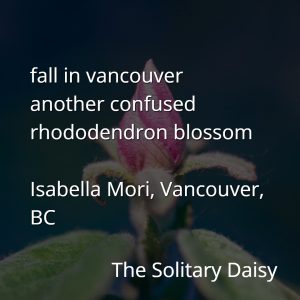
fall in vancouver
another confused
rhododendron blossom

Isabella Mori, Vancouver, BC
canadian prairies—
the kindness of strangers
even in winter.

Cendrine Marrouat
Winnipeg, MB


eight yard kilt—
the pleasure
in his swagger
the kilt is the national dress of Scotland
Tony Williams
Scotland, UK
beaver tracks
lead to an ice hole-
the missing puck

Rebecca Upjohn, Ontario

only in England
folk fall head over heels
for a wheel of cheese
An annual event on Cooper’s Hill, Gloucestershire, where entrants chase a cheese down a steep hill – no, really! – often resulting in broken bones, all for the ‘glory’ and for the cheese
Tracy Davidson
Stratford-upon-Avon, UK
bison footprint—
a western meadowlark
builds her nest

Jenny Mattern
Kalispell, Montana


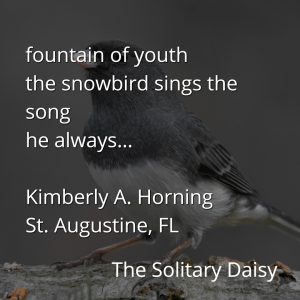
fountain of youth
the snowbird sings the song
he always…
St Augustine is “home” to the Fountain of Youth. Also, snowbird is FL speak for old folks far away from home.
Kimberly A. Horning
St. Augustine, FL







Michele’s Musings
Sally and I enjoyed your haiku about something that is unique to your country, province or town so much. The backstories really added to the enchantment so we have included those as well. You may notice there are ten haiku this issue – we just couldn’t narrow it down!
Submissions for our annual haiku contest are coming in fast and furious according to our webmaster! You have until March 28th to submit.
I just came back from spending a few nights at a high school friend’s apartment in Edmonton. It was wonderful to see her and we spent hours catching up and reminiscing. On the airplane home, some haiku fermented from jostled memories.
This got me thinking about how to approach memories that want to work themselves into haiku. The first way is to act as though the action in the haiku is happening now. No need to refer to memory. Use present tense and remember to be specific.
The second way is to use a present event or item and tie it back to the past memory through association or contrast. That might look something like this:
between life and death
the last leaves
on the maple tree
Either way, have fun with the prompt for this issue: childhood memories!
Sally’s Notebook
“Why,” I asked my son, “do I insist on watching movies that make me cry, just like they did the last half dozen times I’ve watched them?” He had no answer. The truth is, I know why I do it. It’s because I need to cry.
When I was younger, I cried over everything. Reading books, every boy I ever liked, witnessing other people’s grief. I even cried watching an SPCA commercial.
But then I found myself in an abusive marriage lasting more than 25 years. I learned to harden myself, to feel nothing at all. I’m not sure which was worse.
At this point in my life, I’ve relearned how to feel but still, sometimes, have a hard time expressing it. With everything going on in the world, I find myself retreating into my shell – survivor mode. I don’t stop to let myself feel but push on with grim determination to get through this, to survive. There will be time enough for tears after it is all over.
But like a pressure cooker, I need a valve to release some of that steam. Old movies are one way I’ve found to do that.
So, back to those movies…
The other day, I watched an old favorite – Dances With Wolves. I knew I was going to cry. I even knew when I was going to cry. I watched anyway.
The movie starts on a Civil War battlefield and slowly moves to an isolated post on the frontier. Gradually you sink into the surroundings, the calm of this new existence. That, of course, is shattered with the arrival of soldiers to the post. The difference is so abrupt and jarring I found myself wincing at the noise, like nails on a chalkboard.
And that is how I feel right now. My peaceful existence has been broken by a select few brash, entitled men who want control. It’s no wonder I’ve gone into survival mode; the whole world is a trigger to my past.
Of course, you’ve heard it said you can’t always control what happens to you, but you can control how you react to it. This is why the Way of Haiku is so important, not only to those of us who write it, but to those of us who read it as well. Three simple lines to restore the balance. A moment of beauty amidst the chaos. A way to hold onto ourselves in troubled times. It, too, is a steam valve on your pressure cooker.
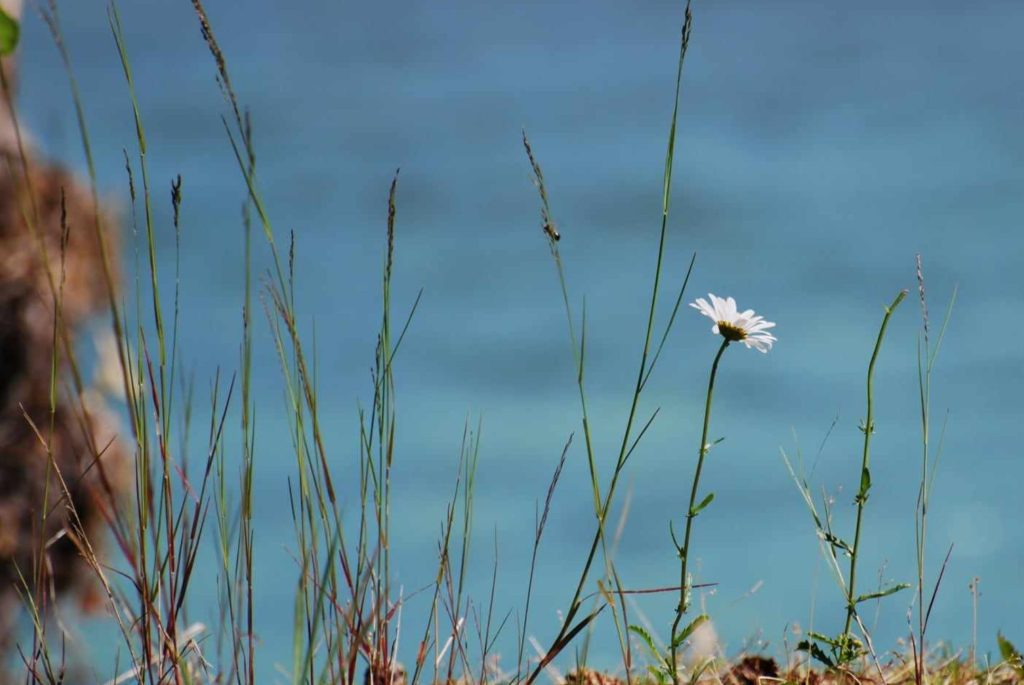
It’s a solitary daisy, rising from the rubble. Write on, my friends, write on.
Member News
The latest edition of The Heron’s Nest has been released. Congratulations to Ruth Holzer, Emil Karla, Joshua St. Claire, Debbie Strange, and Jeral Williams for having their haiku selected. You can read the full issue online here.
From Charlotte Digregorio’s Blog:
counting ways this river bends
back and forth between the sea
already our love has failed
heartbreak guaranteed

by Joanna Ashwell (UK)
Dodoitsu is a Japanese-style poem of four lines with seven syllables each in the first three lines, and five syllables in the fourth. It is untitled, often written about love or work, but can be written on any theme. There is often a comical twist at the end.
Also from Charlotte Digregorio’s Blog,
tea with mandarin
ducks sleeping on the water—
waft of melodies

by Monica Kakkar (India/USA)
The Bamboo Hut, Feb. 9, 2025
And from Café Haiku’s Cityscapes, this selection:
Haiku by Valentina Ranaldi-Adams, USA
city park -
through bare trees
the hum of traffic

mating season -
in the mailbox
a bird's nest

hospital visit -
lost in the parking deck
maze

street fair
the magician winks
as he palms a ball

worker bees
heavy traffic buzzing
into town
Finally, this fantastic piece by Julie Bloss Kelsey on The Haiku Foundation’s New to Haiku
Please feel free to send me your news. I don’t always catch what’s out there and appreciate your assistance in celebrating you!
Places To Submit
The Solitary Daisy Haiku Contest is on until March 28th! Find the details here.
Tsuri-dōrō will be accepting submissions for their May/June 2025 Issue #27 through March 10th.
Sonic Boom accepts any and all forms of short poems as long as they are under 10 lines (excludes lines breaks and title). A non-exhaustive list includes free verse, haiku, senryu, cherita, tanka, gembun, dua, and everything in between. Open for submissions until March 15th.
Charlotte Digregorio seeks submissions of haiku, senryu, tanka, or dodoitsu for her blog, www.charlottedigregorio.wordpress.com. Her blog runs The Daily Haiku with poets from sixty-one countries. Poets may email her with just one poem, previously published or unpublished, at c-books@hotmail.com. Deadline March 15th.
Every year, Moonstone honors International Haiku Day on April 17th. Note: this link goes to their Submittable page. Deadline is March 16th.
The next issue of the Asahi Haikuist Network appears March 21st. Readers are invited to send haiku about “cats in love” or “tears in the rain” on a postcard to David McMurray at the International University of Kagoshima, Sakanoue 8-34-1, Kagoshima, 891-0197, Japan, or e-mail to (mcmurray@fka.att.ne.jp).
Daisy Member Isabella Mori hosts an annual poetry contest and she says they accept haiku. Submit your poetry to the 2025 Muriel’s Journey Poetry Prize. Deadline is March 31st.
Café Haiku’s World Haiku Review is open for submissions until March 31st. The suggested themes are humanity or spring/autumn depending on where you live.
The Haiku Foundation invites you to take part in this month’s kukai! A kukai is a poetry contest where writers submit haiku on a theme. Then all the writers and anyone else with an interest have a chance to read the haiku and vote on their favourite. This month’s theme is violet and submissions are due by March 31st.
2025 ONE ART Haiku Anthology. The editor encourages you to check out ONE ART’s 2024 Haiku Anthology to see what kind of haiku they like. Open for submissions until March 31st.
Medmic Fall/Winter Haiku Contest prefers haiku with traditional structure, but will consider contemporary haiku with slight deviation from traditional form. Poets are encouraged to send haiku poems that relate to wellness or healthcare, but this is not absolutely mandatory. The link goes to their Submittable page. Submissions will be accepted until March 31st.
Poetry Pea is a great haiku resource and also runs monthly themed contests. For March the prompt is a video on their YouTube channel. Deadline for submissions is March 31st.
Under the Bashō Journal has opened for submissions and remains open until November 15th. Take a look at their submission requirements now to make sure you are planning the right haiku to send to them.
Haikuniverse publishes a daily haiku online. Submissions open year-round.
This Week’s Prompt
Your prompt for the upcoming issue is to write a haiku that captures a childhood memory. Submissions are due in by March 19th.
Please see our submission guidelines!
“Reading haiku is as much an art as writing it. The reader needs to pause and listen to the silences, to feel the spaces between the words, and to journey into the depths of many multi-colored worlds.”
–Harley King, Mother, Don’t Lock Me In That Closet!

Michele Rule is a disabled writer from Kelowna BC. She is especially interested in the topics of chronic illness, relationships and nature. Michele is published in the Asahi Shimbun Haikuist, Pine Cone Review, the Enchanted Garden, Five Minute Lit, Shadow Pond, WordCityLit, and the anthologies F*ck the Patriarchy, Chicken Soup for the Soul, and To Live Here, among others. She is an associate member of the League of Canadian Poets and Haiku Canada. Michele has been awarded honourable mention twice for the Vancouver Cherry Blossom Festival Haiku Invitational and also for the Haiku Northwest Porad Award. Her first chapbook is Around the World in Fifteen Haiku. Michele lives in a beautiful garden surrounded by people who love her just the way she is.

Sally Quon is a disabled poet and photographer living in the Okanagan Valley of beautiful British Columbia, Canada. She is an associate member of The League of Canadian Poets and a member of Haiku Canada. Her work has been published in numerous journals including The Heron’s Nest, Modern Haiku, Frogpond, First Frost, and Time Haiku. She is currently working on her first book of haiku, haibun, and haiga, tentatively titled, “My Valley, My Home.”
Featherstone Creative
Thank you so very much for the feature!
I really enjoyed reading the haiku you selected as well. I watched videos of the Cooper’s Hill contest a few years ago on YouTube. It was fascinating.