crossing the bridge
a new sound
the gurgle of freedom
Liz Kornelsen
Winnipeg MB
forget-me-nots
father almost remembers
planting them
Tracy Davidson
Warwickshire, UK
starling or thrush
either way
spring
Hynek Koziol
Prague, Czech Republic
spring cleaning
all the clothes
I no longer fit in
Neha Singh
Soni, India
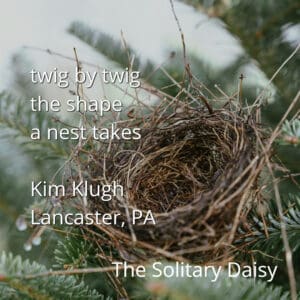
twig by twig
the shape
a nest takes
Kim Klugh
Lancaster, PA
tendrils
wake and stretch -
passion flower
Julie Parker-Kinsey
Auckland, New Zealand
replanting
her hands tattooed
by the earth
Margaret Anderson
Vancouver
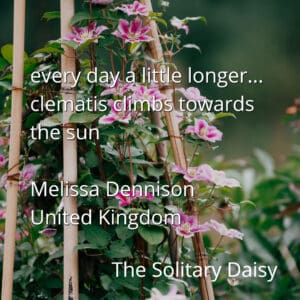
every day a little longer…
clematis climbs towards
the sun
Melissa Dennison
United Kingdom
false spring
my son’s recorder
slips out of tune
Adele Gallogly
Hamilton, Ontario, Canada
late spring
landing in the rugby pitch
— the last Brent geese
Clodagh O Connor
Dublin, Ireland
saffron sunrise
I breathe in the scent
of snowdrops
Chen-ou Liu
Ajax, Ontario, Canada


Michele’s Musings
Hello friends!
As I write today, I’m full of sadness with the world events. So when I spotted a small house finch with the signs of avian pox on our bird camera, the tears came quickly. I know he won’t live to see the next weeks. Frithjof, our webmaster, went right out to take down the feeders and empty and bleach them. The feeders need to stay down for two weeks and I’m worried about my little friends. The joy of birds is a big part of my mental health strategy and I’m not sure how I will manage.
So this is where you come in. What birds are you seeing in your neighbourhood? Are winter’s migrants returning? I am so looking forward to receiving your haiku to tide me over until my own feathered companions are able to return.
The countdown clock is up now for our annual Haiku Contest. Start thinking about which of your haiku you might want to polish up. Editing is a good way to improve your haiku. But remember to keep your previous versions. Sometimes when I edit, my haiku ends up so far from the original that I am able to go back and take the original haiku down another path. Also sometimes my editing just doesn’t work out and I end up going back to the original. Never throw anything out!
Keep writing!
In the Whitespace with Sean
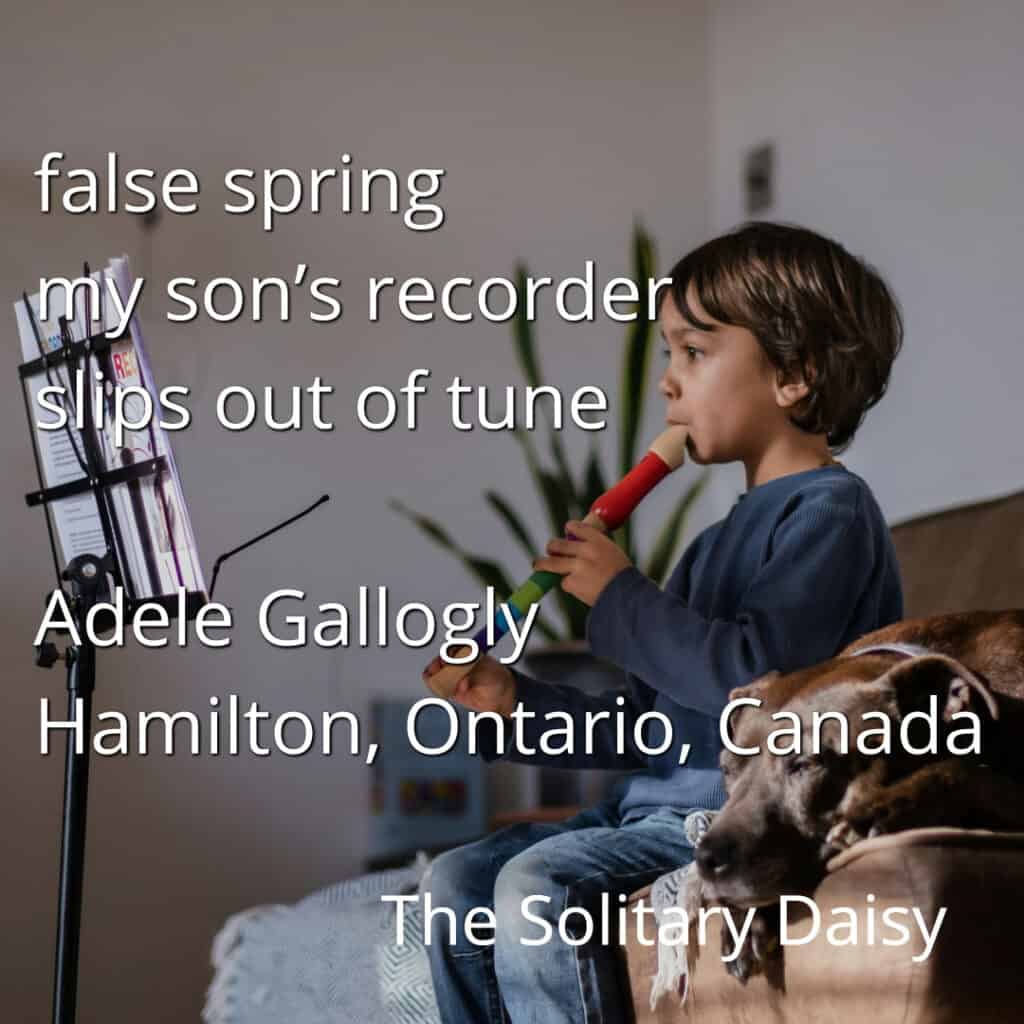
false spring
my son’s recorder
slips out of tune
Adele Gallogly
Hamilton, Ontario, Canada
This is a deft seasonal haiku that links natural fluctuation with a small domestic moment. Its strength lies in the quiet mirroring between climate and sound.
“false spring” is an excellent kigo-like phrase. It names a specific seasonal phenomenon — a brief warm spell in late winter that suggests spring has arrived, only for cold to return. The phrase carries instability and uncertainty from the outset.
It sets up the poem’s emotional field: something temporarily promising that cannot quite hold.
“my son’s recorder / slips out of tune” provides the second image. The recorder, a child’s instrument often associated with early music lessons, introduces both sound and family life.
The connection between the two parts is subtle but effective:
● False spring → weather that cannot sustain warmth
● Recorder slipping out of tune → music that cannot sustain pitch
Both images convey instability and a slight sense of disappointment.
The phrase “slips out of tune” is particularly well chosen. “Slips” conveys gradual loss rather than sudden failure, mirroring how false spring slowly reveals itself as temporary. The soft sibilants in “false,” “son’s,” “slips” create a faint whispering quality, almost like air moving through the recorder itself. The word “recorder” also carries an airy, breath-driven sound in the mind of the reader.
The poem is gently humorous without being mocking. Anyone who has heard a child practising the recorder can recognize the wavering pitch. Yet the poem treats the moment with affection rather than irritation. There is also a deeper resonance: childhood learning, like early spring warmth, is tentative and uneven.
The poem stays firmly within observation. There is no explanation of the connection between season and instrument. The reader completes that relationship, which keeps the haiku open and engaging.
Overall, a well-balanced haiku is built on parallel instability. The shifting weather of “false spring” and the wavering note of a child’s recorder echo each other quietly, creating a moment that is both seasonal and domestic. Lightly humorous, perceptive, and neatly composed.
Member News
Sadly, we didn’t get any member news this month, even though we saw that many of you had things published. Please remember to send things in so we can celebrate with you!
Sally’s Notebook
In the publishing world, as any editor will tell you, the overuse of exclamation points is a sure fire way to get your manuscript rejected. But for poet Rosemerry Wahtola Trommer, an exclamation point is a keyhole to wonder. Baby’s breath! A blue marble! The water garden!
!
for Mark Burrows


And there, in your letter, several doors,

all of them in the shape of an exclamation point,

all invitations to slip myself through

their dark slender lines and into

the realm of ecstasies—world of oh!

and wow! and yes! and love!—

into the sensory kingdom of blisses

that is always here, and yet somehow

I miss it, dulled as I am by the ellipses

of shoulds, the endless commas

that join me to the litany of frying pan,

dish soap, calendar, telephone,

toothbrush, postage stamp, pillow.

But oh! The wide spiralling of eagle this morning!

The deepening rose of the clouds at dawn!

My daughter asleep in her room!

Oud! Ginger! Dark crimson yarn!

Emptiness! Cool breeze! Your letter!

What joy this morning when I saw

all those tall, slim exclamation marks

and recognized them as the doors they are,

each one the chance to say yes! Yes!

to vibrating with elation! Yes! to the bright

bubbling champagne giddiness that rises inside

because wing!

Because spring!

Because sun!

Because pillow!

Because toothbrush!

Because breath!

Because orange!

Because toes!

Because you!

—Rosemerry Wahtola Tromme
In the last issue, I talked about the photo not taken. To me, haiku is the photography of the soul. Those photos are meant to be taken.
Haiku is born of exclamation points and wonder. May your day be full of both, and in the words of another poet, the late Mary Oliver,
“Instructions for living a life.

Pay attention.

Be astonished.

Tell about it.”
If you are interested in reading more of Rosemerry Wahtola Trommer’s work, check out her website: wordwoman.com
Places to submit
Charlotte Digregorio seeks previously published tanka for her blog. You may email her at c-books@hotmail.com with JUST ONE tanka, including the name of the journal, issue number, and year of its original publication. Please submit by March 15.
Wales Haiku Journal is open for submissions until March 31st. Work submitted may be on any theme or subject, but works that embody the nature tradition of haiku are particularly keenly sought.
The reading period for Frogpond is now open. Send in your haiku by March 31st to be considered for the spring/summer issue.
The 2026 confluence Poetry Prize invites your submission of one Japanese short form poem on the theme of death and dying. They will award $500 in total prize money for the best poems on this theme that expand our capacity for imagining and illuminating this human existence. Submissions are due by May 1, 2026.
The Vancouver Cherry Blossom Festival Haiku Invitational is an international online contest that attracts submissions from all over the world. Submissions on the theme of cherry blossoms close on June 1st.
Don’t forget that we are open for haiku collections based on the February prompts! Send us 15 haiku by March 25th to be considered.
This Week’s Prompt
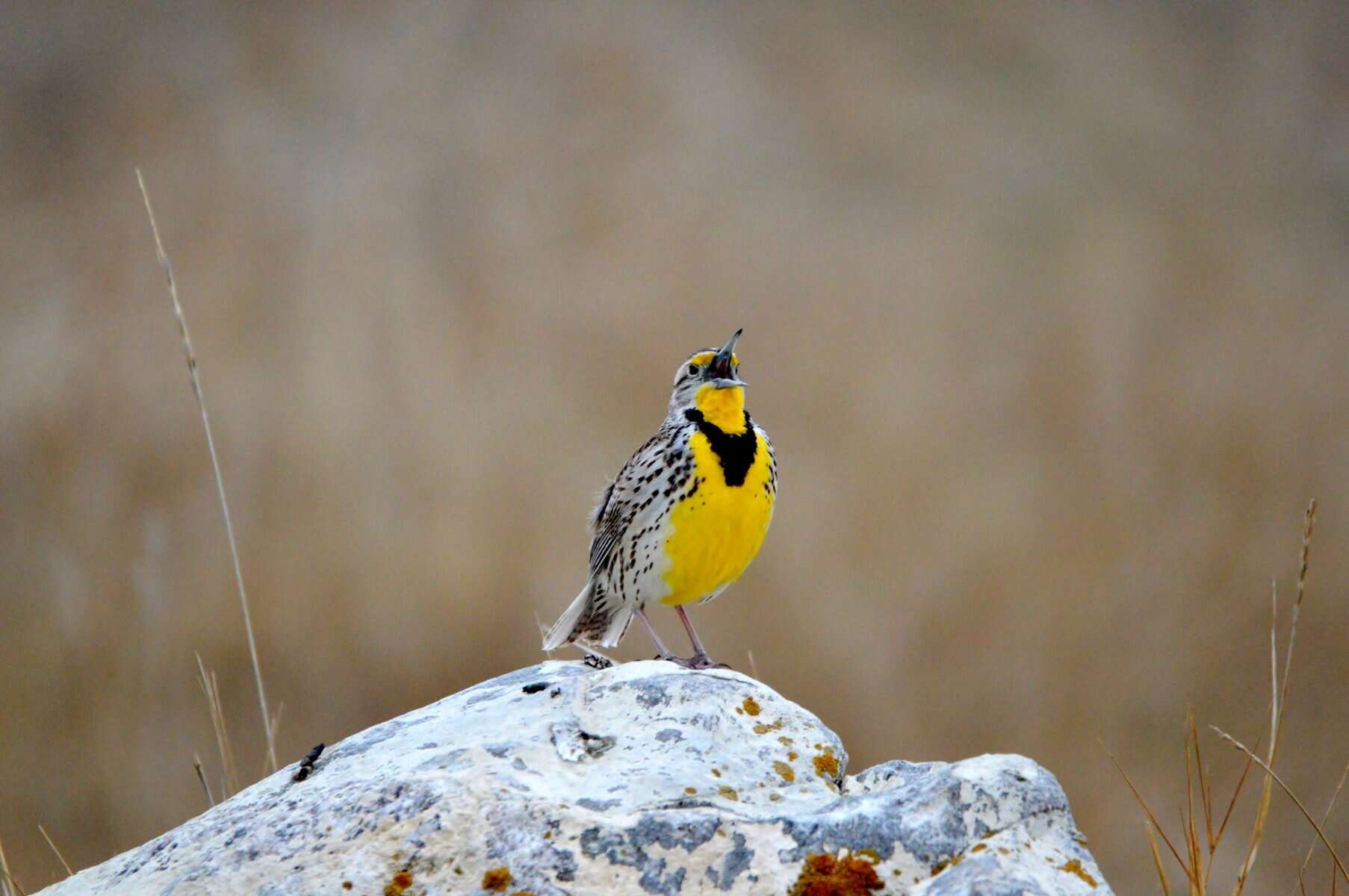
We loved your signs of spring haiku and would now love to hear more about the birds of spring in your region! Send one or two haiku by Sunday, March 22nd.
Send one or two haiku to sally_quon@yahoo.com or to Michele at kelownalady@hotmail.com. Find our full submission info here. Don’t forget to tell us where you are writing from!
mountain-rose petals— Matsuo Bashō
falling, falling, falling now…
waterfall music

SB Wright (Seàn Wright) is a disabled poet living in the South Australian Mid-North. Born in Nhulunbuy in Arnhem Land, he spent most of his life in Alice Springs before relocating south. A graduate of NTU, his working life has ranged widely, including roles as a security guard, martial arts instructor, trainer for an international gaming company, teacher librarian, and primary school teacher. In 2024, he became disabled due to AL Amyloidosis.
Japan and Japanese culture have been lifelong interests. While his poetry ranges from formal to free verse within the Western tradition, Japanese poetry and its English-language offshoots hold a special place in his work. His poems have been published in Verity La, Tincture Journal, Eureka Street, A Hundred Gourdes, INDaily Adelaide, Folk Ku Journal, and the anthologies The Stars Like Sand and 50 Haikus. His first collection of poetry (including Haiku and Haibun is Magpie Tales through Close-Up Books.
h.

Sally Quon is a disabled poet and photographer living in the Okanagan Valley of beautiful British Columbia, Canada. She is an associate member of The League of Canadian Poets and a member of Haiku Canada. Her work has been published in numerous journals including The Heron’s Nest, Modern Haiku, Frogpond, First Frost, and Time Haiku. She is currently working on her first book of haiku, haibun, and haiga, tentatively titled, “My Valley, My Home.”
Featherstone Creative

Michele Rule is a disabled writer from Kelowna BC. She is especially interested in the topics of chronic illness, relationships and nature. Michele is published in the Asahi Shimbun Haikuist, Pine Cone Review, the Enchanted Garden, Five Minute Lit, Shadow Pond, WordCityLit, and the anthologies F*ck the Patriarchy, Chicken Soup for the Soul, and To Live Here, among others. She is an associate member of the League of Canadian Poets and Haiku Canada. Michele has been awarded honourable mention twice for the Vancouver Cherry Blossom Festival Haiku Invitational and also for the Haiku Northwest Porad Award. Her first chapbook is Around the World in Fifteen Haiku. Michele lives in a beautiful garden surrounded by people who love her just the way she is.