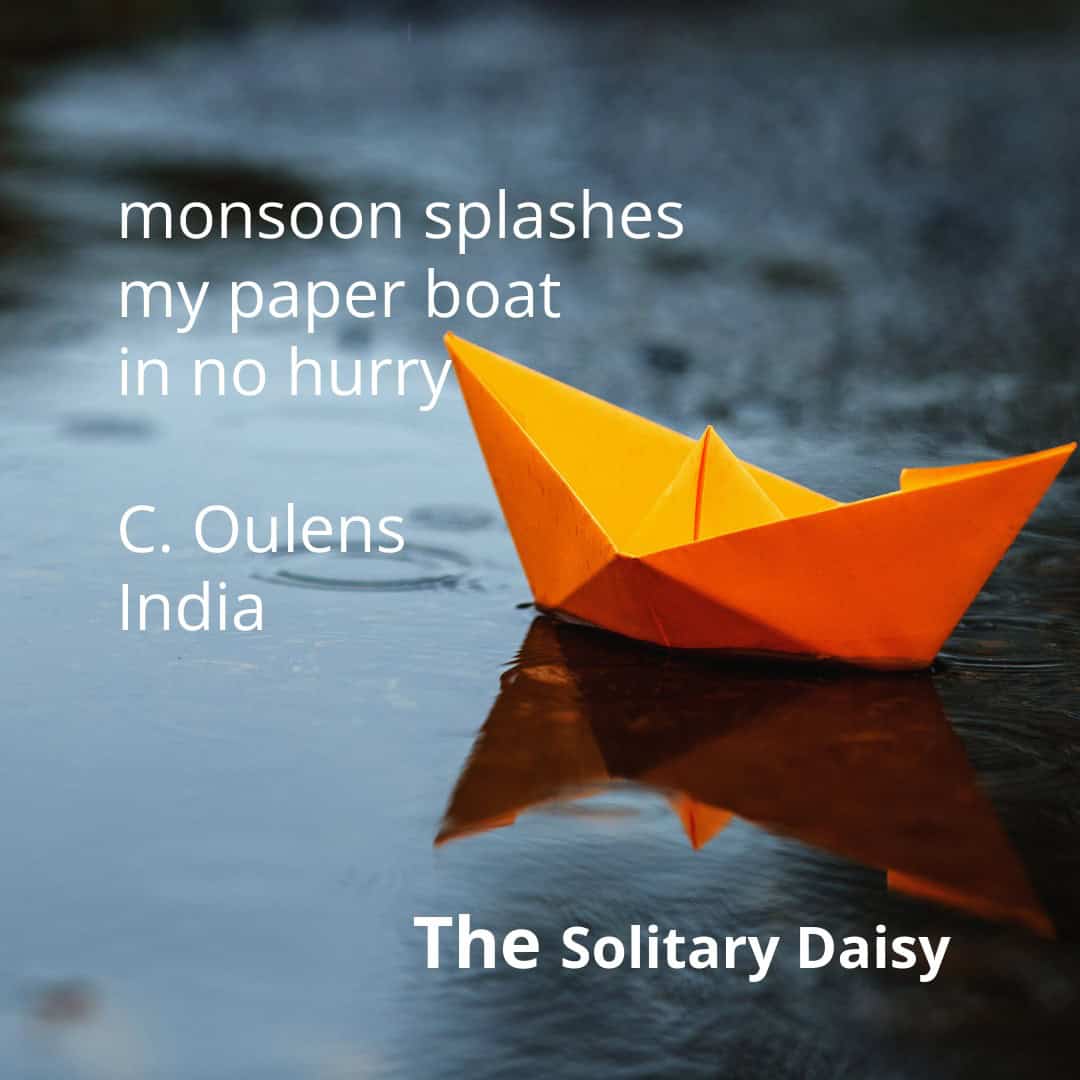
monsoon splashes
my paper boat
in no hurry
C. Oulens
India
black ants scurry
you can’t hurry up
a peony bud
Randy Brooks
Taylorville, IL
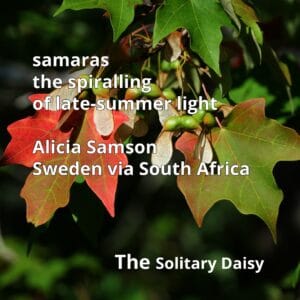
samaras
the spiralling
of late-summer light
Alicia Samson
Sweden via South Africa
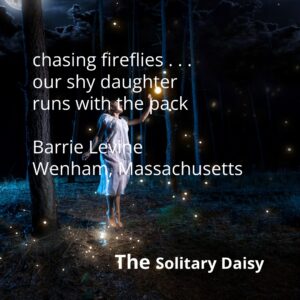
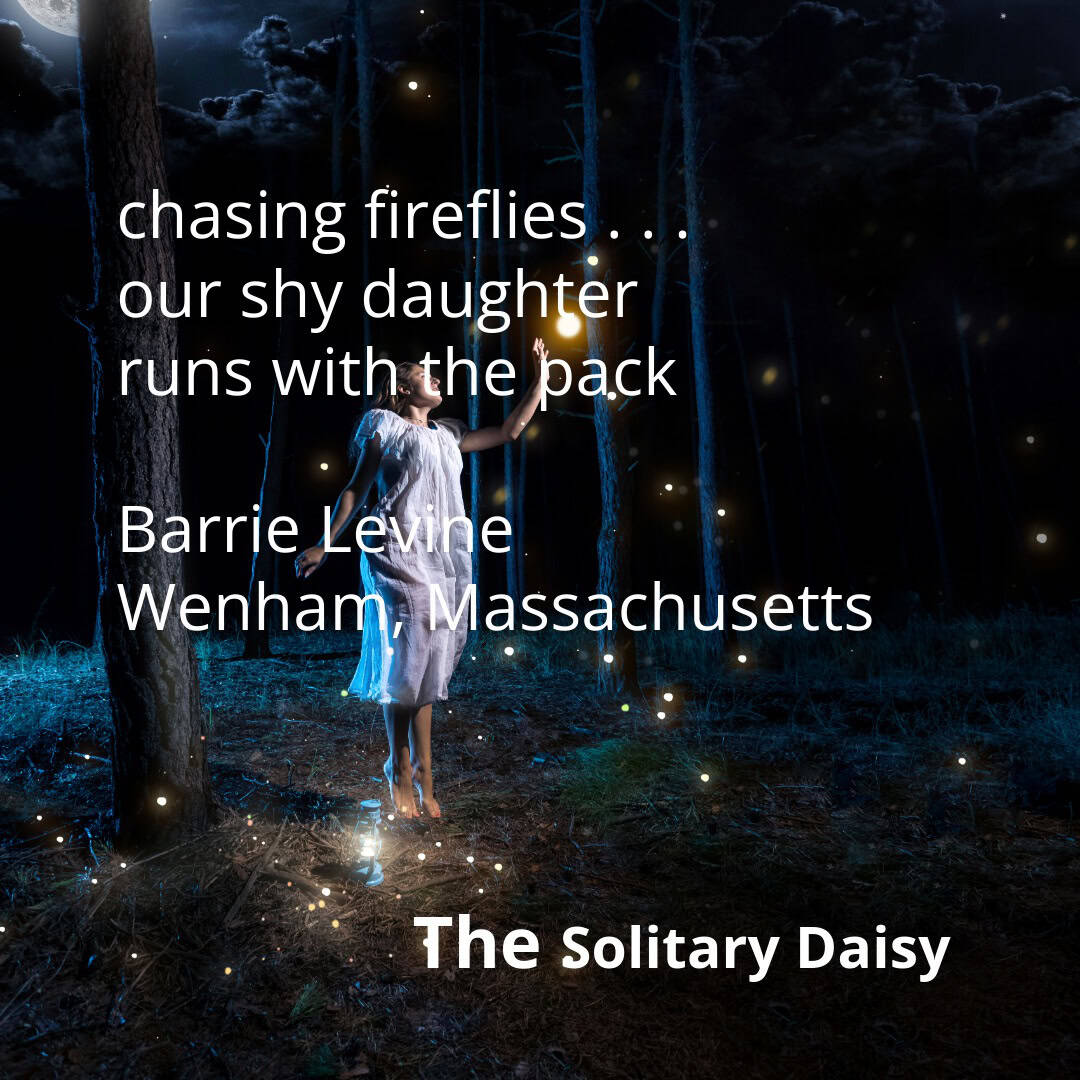
chasing fireflies . . .
our shy daughter
runs with the pack
Barrie Levine
Wenham, Massachusetts
afterimage—
the kingfisher returns
before the splash
Fabbiha Islam Nawal
Dhaka, Bangladesh
hasty departure
just her and the red leaf
on the car window
Urszula Marciniak
Łódź, Poland
adrenaline rush -
premature celebration
with a lap to go
Paul Callus
Malta
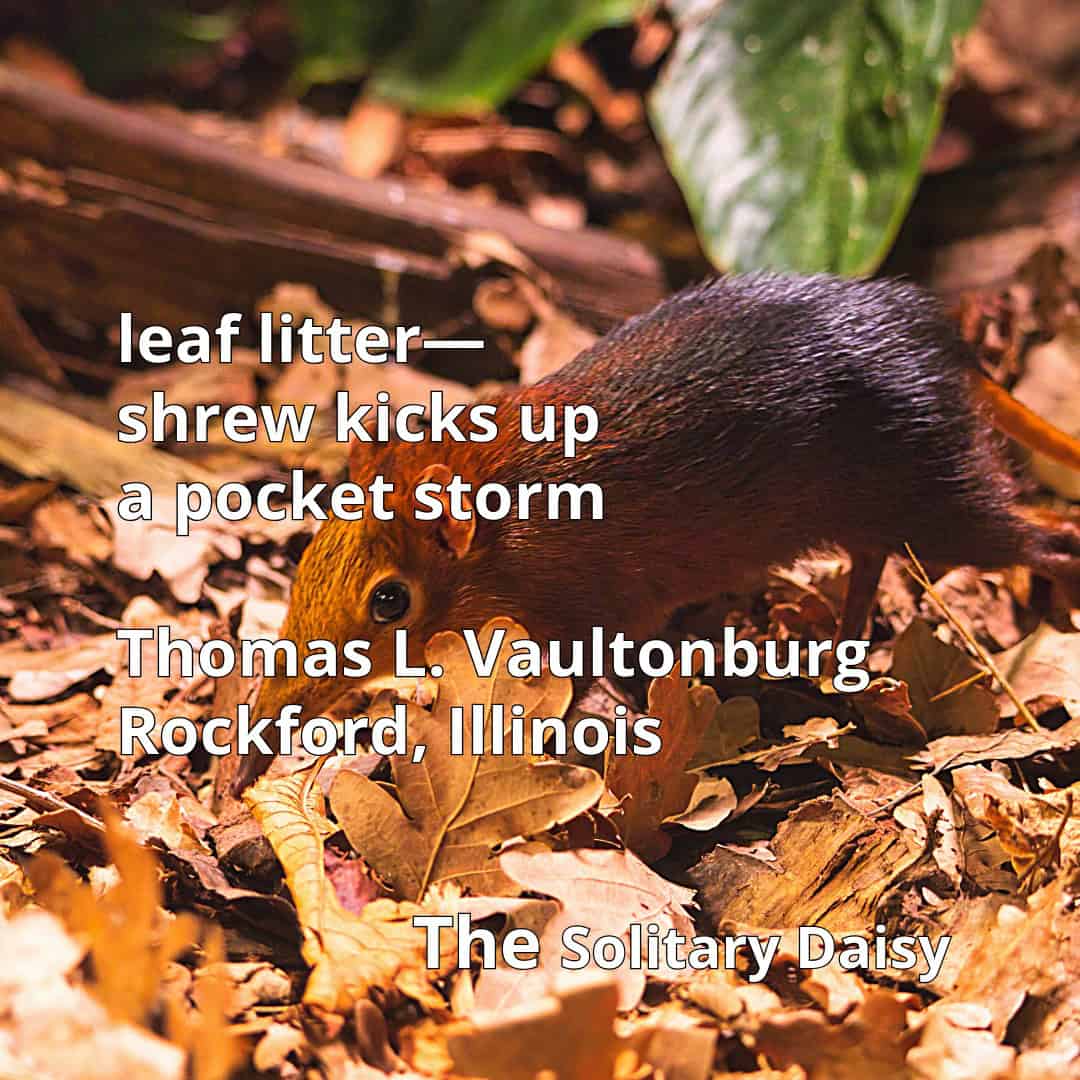
leaf litter—
shrew kicks up
a pocket storm
Thomas L. Vaultonburg
Rockford, Illinois
hometown village
catching the bus
into dust clouds
Hifsa Ashraf
Rawalpindi, Pakistan
one sandal loose
the train
takes the curve
Nalini Shetty
India





Michele’s Musings
Hello friends!
It’s been a summer for the record books here! 65 days without rain. Days that were so smoky we became the most polluted place in the world. Forest fires to the north and south of us.
It was stressful, not gonna lie.
Frithjof and I did manage a retreat from it all to Sechelt, BC. I attended the Sunshine Coast Festival of the Written Arts and met some new writers. Coming home to continued smoke had us seriously considering a move!
So we were relieved when rain finally arrived here a few days ago and that moisture has been welcomed by people, the fauna, and the flora of this land. This inspired a prompt – what does rain mean to your area? Is it welcomed or is it a challenge? How does the land respond?
Keep on writing!
Member News
Laurinda Lind
Here are some haiku publications I’ve been lucky to have so far this summer: two in The Red Thread Project of the World Parkinson Project; two in Renku Sessions; one each in Haiku Dialogue and Charlotte DeGregorio’s The Daily Haiku blog.
Laurinda Lind, Sackets Harbor, NY
—
Joanna Ashwell
I was honored in several contests/kukai and THF dialogue in the last two months.
I included the haiku/senryu and notations.
balancing on a long slow breaking wave fatherhood
The Haiku Society of American Senryu Award
Honorable Mention 2026
autumn dusk
the arthritic curvature
of pines
2nd Prize, The Haiku Foundation Monthly Kukai, July, 2026 aging hingiPhonebation
The Haiku Foundation Haiku Dialogues, Short List, August 5, 2026
Bruce H. Feingold, Ph.D. Berkeley, CA
I have been one of the featured readers for the annual HPNC Two Autumns reading in August and have just received a runner-up best of issue from Autumn Moon Haiku Journal.
Joanna Ashwell, UK
—
Thomas L. Vaultonburg
As a regular subscriber to The Solitary Daisy, I thought I’d mention that my new haiku collection, Vanished Roads, was released earlier this summer. Much of it explores the quiet intersections of nature and Zen practice, so I thought it might be of interest to you. If you’d like to take a look, you can find it here:
https://wolftwin.com/vanished-roads
Thomas L. Vaultonburg, Rockford, Illinois USA
—
Michele Rule was honoured to have this haiku published in Frogpond this summer.
preparing the garden for spring
row upon row
of schoolgirls' graves
(Frogpond 49.2 2026)
Don’t forget to send us your haiku news – we would love to celebrate you in this space!
In the Whitespace with Sean
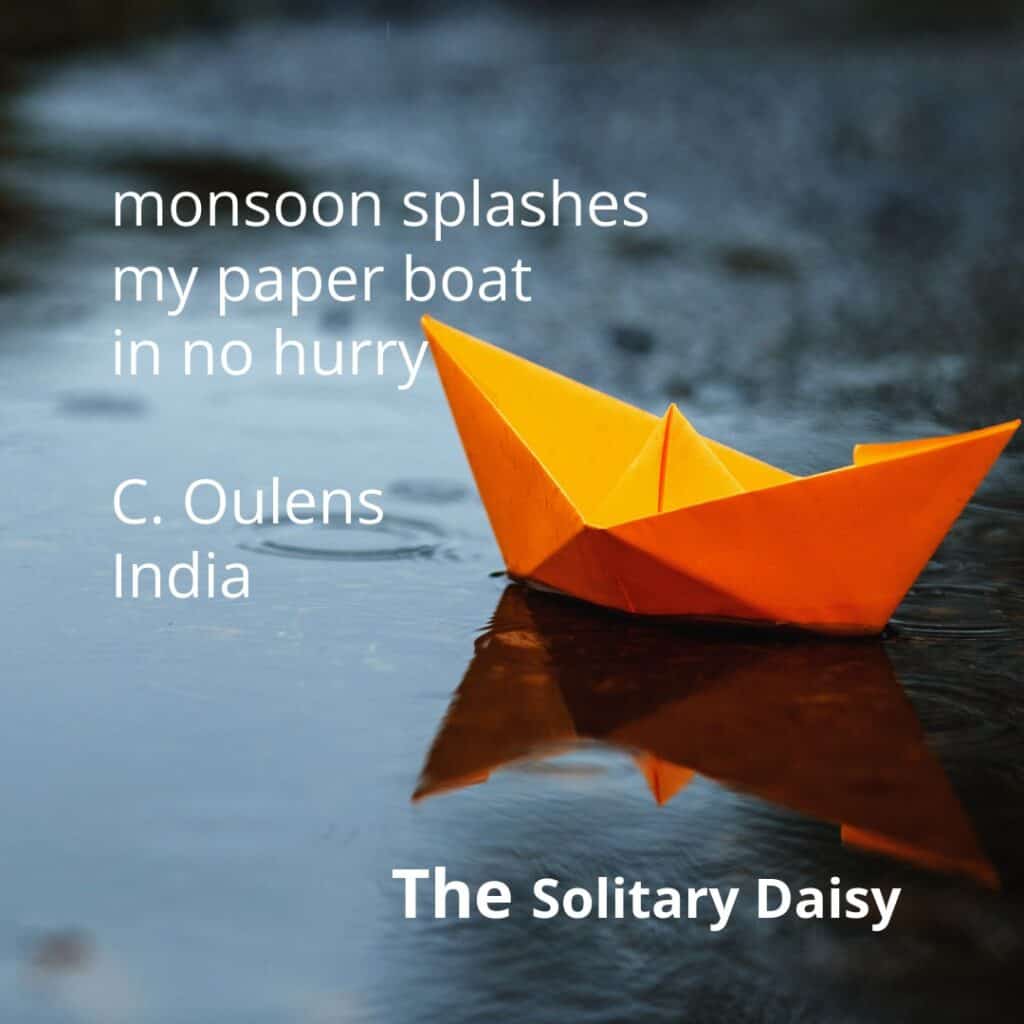
This is a deceptively simple haiku. On its surface, it captures a playful image: a small paper boat being moved by the rain during a monsoon. Yet the final phrase transforms the image into something more contemplative. What begins as an observation of rain and a child’s toy becomes a meditation on movement, surrender, time and the freedom of not needing to arrive anywhere quickly.
The opening, “monsoon splashes,” is immediate and energetic. “Monsoon” gives the poem a particular climatic setting, while “splashes” provides the sound and physicality of the rain. There is an exuberance in the word: the monsoon isn’t presented as threatening or oppressive but as something almost playful — perhaps it’s the start of a downpour with large drops hitting the water’s surface and creating large ripples. The enormous scale of the monsoon is also important when placed against the tiny paper boat that follows. A vast natural force is carrying something extraordinarily small and fragile.
With, “my paper boat” the poet brings the human presence into the poem. The paper boat immediately evokes childhood: making something from an ordinary piece of paper and setting it afloat simply to see where it will go. But paper also introduces vulnerability. A paper boat can survive only temporarily in water before becoming saturated and collapsing. Its journey is therefore inherently impermanent.
The possessive “my” adds another layer. The speaker has presumably made or released the boat, but once it is on the water, control is surrendered. The boat’s direction is determined by the water, the rain and whatever current is present. The speaker has created it, but cannot determine its destination. This makes the boat an effective image for the relationship between human intention and forces beyond our control.
The real turn comes with “in no hurry.” This is the poem’s most interesting phrase because it doesn’t simply describe the boat’s speed. “Slowly” would have done that. “In no hurry” describes an attitude toward time. The boat appears to possess an awareness—or acceptance—of its own pace.
There is a gentle humour in this personification. A paper boat obviously has no schedule and cannot consciously hurry. Yet giving it this human quality allows the poet to project an attitude onto it. The boat isn’t rushing toward a destination. It is simply being carried.
There is also a distinctly childlike quality to the scene. Children can spend considerable time watching a paper boat drift without needing the activity to accomplish anything. The boat has no productive purpose. It doesn’t need to get anywhere. It exists for the pleasure of watching it move. “In no hurry” consequently suggests not only philosophical acceptance but the freedom of play—the ability to experience something without immediately asking what it is for.
This gives the haiku a quiet contemporary resonance. Against a culture obsessed with productivity, efficiency and acceleration, the little paper boat becomes an almost comic counterexample. It has no timetable, no optimisation strategy and no destination that matters. It simply goes where the water takes it.
There is also an undercurrent of impermanence. The reader knows that the paper boat’s journey will not last. Eventually the paper will become waterlogged and the boat will collapse. The poem doesn’t dwell on that ending, however. It remains with the boat’s present journey. This gives the haiku a gentle awareness of transience without turning it into melancholy.
The relationship between the first and final lines is particularly effective. “Monsoon splashes” is full of movement and noise; “in no hurry” is quiet and relaxed. The poem therefore begins energetically and ends by slowing itself down. Even the sound seems to decelerate. The sibilance of “monsoon splashes” gives us the sound of rain, while the softer rhythm of “in no hurry” creates a sense of release.
There is also a compelling contrast of scale. The monsoon is elemental and immense. The paper boat is tiny and fragile. The final line then moves away from physical scale into psychological scale: the question becomes not how powerful the monsoon is, but how the boat—or the speaker—responds to that power.
This is where the poem sits very comfortably within haiku. The human insight isn’t stated directly. There is no declaration such as “I need to slow down” or “I shouldn’t worry about the future.” Instead, the thought is embodied in the image. The reader is allowed to discover the possibility of a different relationship with time by watching the boat.
The poem does, however, have a touch of senryu DNA because the final line is essentially a human attitude projected onto nature. If the poem were to explicitly introduce the speaker’s own feelings about haste, it would move much closer to senryu. As it stands, though, the natural image remains dominant and the human significance is implicit, making haiku the stronger classification.
The familiar metaphor of a boat representing life’s journey could potentially make the poem feel conventional. Likewise, the idea of being “in no hurry” is hardly novel in itself. What saves the poem from becoming a generic statement about slowing down is its particularity: the monsoon and the paper boat. The combination gives the familiar idea a fresh physical embodiment.
Most importantly, the poem does not tell us whether the speaker has deliberately adopted the boat’s attitude or merely recognises it. That ambiguity is valuable. Perhaps the speaker is simply watching a child’s paper boat drift through the rain. Perhaps the speaker envies it. Perhaps the boat has become an unconscious image of a life that no longer needs to hurry toward some predetermined destination.
The poem ultimately suggests that movement and urgency are not the same thing. One can be moving through powerful circumstances without constantly demanding progress, achievement or arrival. The little paper boat doesn’t resist the monsoon, nor does it race ahead of it. It simply goes.
That is what gives this small haiku its philosophical charm: the boat has nowhere it needs to be, and for this brief moment, neither does the reader.
Just For Fun
Sally and Michele are still collecting season words from across Canada! We are especially interested in the Maritimes, Quebec, Ontario, and the Prairies. We are excited to have a collab going with a Northern Canadian group for words from that region. Please mark your email “season words” and send to kelownalady@hotmail.com.
Registration for the Seabeck Haiku Getaway is now open! If you have never traveled to the west coast of Washington this is your chance to enjoy a unique and beautiful countryside and meet some awesome haiku poets!
Sense & Sensibility is looking for submissions on a Halloween theme! Submissions will open September 1st and end September 10th at noon ET, unless they reach their quota sooner. Please send early to increase your chances of being published.
Join Wee Sparrow Press and Diana Webb for a free haibun workshop on Sunday, September 13th at 2 pm UK time! There is only room for 98 participants so come a bit early to secure a spot.
The Pakistan Japan Cultural Association is holding its first International English Haiku Contest! Send a maximum of one haiku and/or one senryu by September 30th.
WOW! Women On Writing will be hosting a workshop on Ekphrastic Haiku led by Lorette C. Luzajic, editor of The Ekphrastic Review and The Mackinaw. The two hour workshop will be held online at 3 pm, September 15th. There is a fee.
General submissions are open for the Origami Poems Project! They have been publishing microchaps of poetry since 2009 so this is their 13th year providing free poetry! Submissions are accepted any time.
#FemkuMag is open for submissions for their autumn/winter issue, edited by Kelly Sargent & Rowan Beckett Minor. Open to women, non-binary, & trans-identifying poets only.
The 2026 Trailblazer Contest will focus on zuihitsu. Almost anything goes. Any format. Any medium that can be shared in a PDF (including via links). Think multimedia. Think about the way of the brush. Submission window runs September 1st to 30th.
The Haiku Shack Anthology is a new series curated and edited by Cendrine Marrouat and Sherri J Moye-Dombrosky. Each volume will contain a maximum of 50 haiku selected from contributors living around the world. Submissions for the upcoming issue must be in by September 30th.
Enjoy the fall issue of Heron’s Nest – it’s full of lovely haiku. Reading haiku is a great way to learn to write haiku.
Check out the amazing line up of courses at Call of the Page for 2026/2027! These always fill up quickly so don’t delay if you are interested.
The Solitary Daisy Winter Haiku call is now open. Please send one winter themed haiku by October 31st. We will choose 25 haiku for use in an electronic advent calendar that will be shared with everyone. Please put “winter haiku” in the subject line and send to kelownalady@hotmail.com. Don’t forget your name and country!
This Week’s Prompt

Photo by Alex Dukhanov on Unsplash
Send us one or two haiku about rain! Is it welcomed where you live, or is it a challenge? How does the land respond? Deadline for submissions is September 13th.
Send one or two haiku to sally_quon@yahoo.com or to Michele at kelownalady@hotmail.com. Find our full submission info here. Don’t forget to tell us where you are writing from!
“Life isn’t about waiting for the storm to pass…It’s about learning to dance in the rain.
― Vivian Greene

SB Wright (Seàn Wright) is a disabled poet living in the South Australian Mid-North. Born in Nhulunbuy in Arnhem Land, he spent most of his life in Alice Springs before relocating south. A graduate of NTU, his working life has ranged widely, including roles as a security guard, martial arts instructor, trainer for an international gaming company, teacher librarian, and primary school teacher. In 2024, he became disabled due to AL Amyloidosis.
Japan and Japanese culture have been lifelong interests. While his poetry ranges from formal to free verse within the Western tradition, Japanese poetry and its English-language offshoots hold a special place in his work. His poems have been published in Verity La, Tincture Journal, Eureka Street, A Hundred Gourdes, INDaily Adelaide, Folk Ku Journal, and the anthologies The Stars Like Sand and 50 Haikus. His first collection of poetry (including Haiku and Haibun is Magpie Tales through Close-Up Books.
h.

Michele Rule is a disabled writer from Kelowna BC. She is especially interested in the topics of chronic illness, relationships and nature. Michele is published in the Asahi Shimbun Haikuist, Pine Cone Review, the Enchanted Garden, Five Minute Lit, Shadow Pond, WordCityLit, and the anthologies F*ck the Patriarchy, Chicken Soup for the Soul, and To Live Here, among others. She is an associate member of the League of Canadian Poets and Haiku Canada. Michele has been awarded honourable mention twice for the Vancouver Cherry Blossom Festival Haiku Invitational and also for the Haiku Northwest Porad Award. Her first chapbook is Around the World in Fifteen Haiku. Michele lives in a beautiful garden surrounded by people who love her just the way she is.